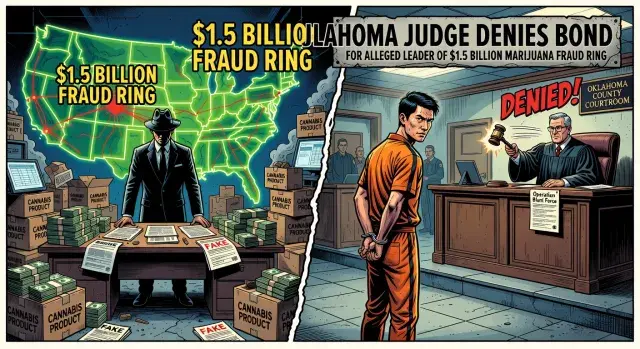
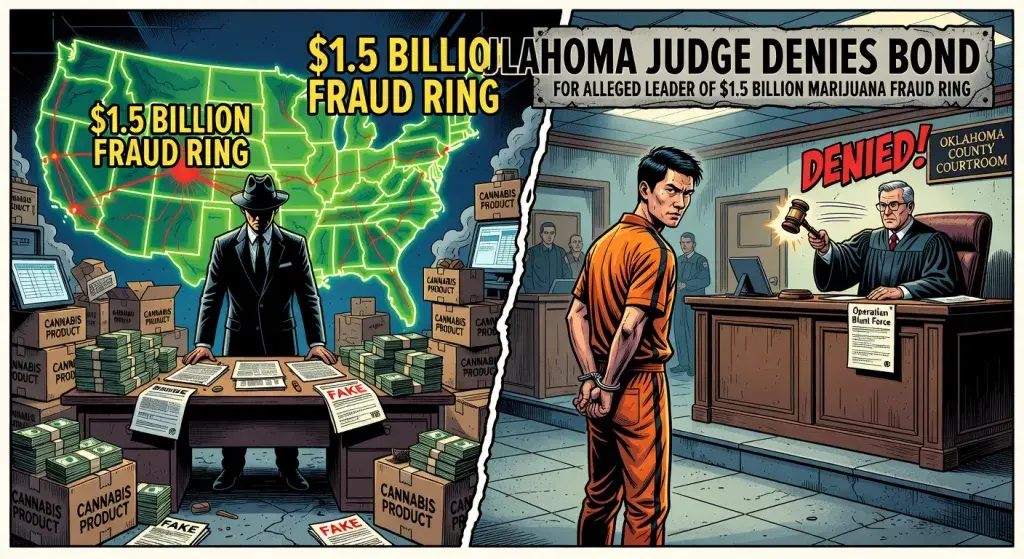
An Oklahoma County judge has denied bond entirely for Hao Chen, the accused mastermind behind a sprawling fraudulent medical marijuana licensing operation spanning multiple states. Chen faces 18 felony counts stemming from an indictment tied to an investigation dubbed Operation Blunt Force - and with the court's ruling, he will remain behind bars as the case moves forward.
The Scale of the Alleged Scheme
The numbers here are staggering. Prosecutors allege that the Hao Chen Organization orchestrated a $1.5 billion fraudulent medical marijuana licensing scheme, a figure that places this case among the largest cannabis-related criminal operations ever pursued by a state attorney general's office. The operation reportedly reached across state lines, though the full geographic scope and the identities of all co-conspirators have not been publicly detailed.
What's striking is how the legal marijuana industry's rapid, state-by-state expansion has created fertile ground for exactly this kind of alleged fraud. Oklahoma, which approved medical marijuana through a 2018 ballot measure, quickly became one of the most permissive licensing environments in the country - at one point issuing more grow licenses per capita than virtually any other state. That openness attracted legitimate entrepreneurs. It also, prosecutors now argue, attracted criminal enterprises willing to exploit the system at an industrial scale.
A Bond Fight That Signaled the Stakes
The denial of bond didn't come without a fight. An Oklahoma County court had previously set Chen's bond at $100,000 - a figure that drew sharp public criticism from Attorney General Gentner Drummond, who argued that it was wildly insufficient given the magnitude of the allegations. A $100,000 bond for someone accused of running a billion-dollar criminal enterprise? The math didn't sit well with the AG's office.
Drummond pushed back, filing a motion to deny bond outright. The court ultimately agreed. In a statement, Drummond framed the ruling as proportionate to the threat: "The court's decision to deny bond entirely recognizes that an individual accused of running a billion-dollar criminal operation and facing 18 felony counts poses a significant risk to our community." He also signaled that Chen is not the only target - promising to "hold all those responsible for this illegal operation fully accountable under the law."
That last line matters. Eighteen felony counts against one individual suggest a complex, multi-layered prosecution. The word "organization" in the case name implies additional defendants, cooperating witnesses, or both. In practice, these kinds of cases tend to unfold in stages.
Broader Implications for Cannabis Enforcement
This prosecution sits at an uncomfortable intersection of state cannabis policy and criminal law. Medical and recreational marijuana programs now operate in dozens of states, but the regulatory infrastructure governing them varies enormously. Some states impose strict ownership caps, residency requirements, and seed-to-sale tracking. Others - Oklahoma being a notable example until recent legislative reforms - operated with comparatively lighter guardrails, at least in the early years.
The result has been a patchwork system where bad actors can exploit gaps between states, obtaining licenses through fraudulent means, using straw owners, or laundering proceeds across jurisdictions. Federal prohibition adds another layer of complexity; the lack of a unified national regulatory framework means that interstate coordination on enforcement often depends on ad hoc cooperation between attorneys general and law enforcement agencies.
Operation Blunt Force appears to be one of the more ambitious examples of that cooperation in action. Whether it becomes a template for future multi-state cannabis enforcement efforts remains to be seen - but the sheer dollar figure attached to the case guarantees it will be closely watched by regulators, prosecutors, and industry participants alike.
What Comes Next
With bond denied, Chen will remain in custody as the case proceeds through Oklahoma County's court system. Eighteen felony counts means a complex trial, likely months - if not longer - away. The AG's office has made clear it views this as more than a single prosecution; it's a statement about the state's willingness to pursue large-scale fraud within its cannabis program aggressively.
For an industry still fighting for mainstream legitimacy, cases like this cut both ways. They demonstrate that enforcement mechanisms exist and can work. But they also remind the public - and skeptical legislators - that legal cannabis markets, when poorly regulated, can become vehicles for fraud on an extraordinary scale. One and a half billion dollars extraordinary.