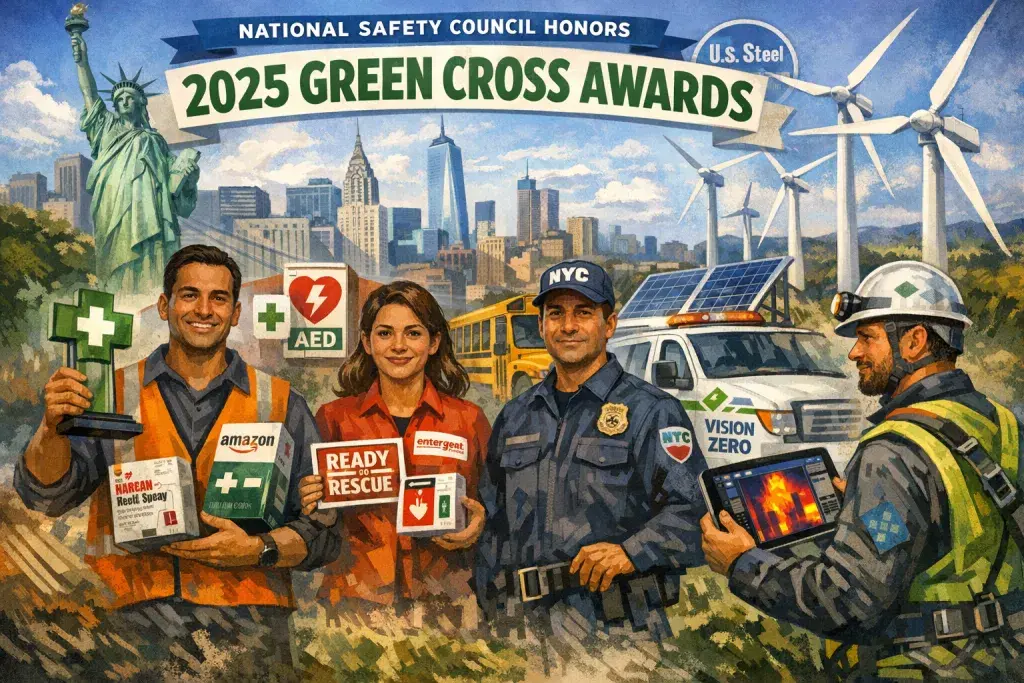
The National Safety Council revealed the 2025 Green Cross for Safety award winners at its 26th annual celebration, presented by U.S. Steel. Amazon and Emergent BioSolutions earned Safety Advocate honors for expanding naloxone access amid the opioid crisis. The New York City Department of Citywide Administrative Services took Safety Excellence, while Puget Sound Energy claimed Safety Innovation for remote monitoring in wind turbines.
Safety Advocates Combat Opioid Overdoses in Workplaces
Amazon responded to calls from public health officials by stocking over 1,200 North American facilities with naloxone by the end of 2025. The company trained all 36,000 first aid, AED, and CPR-certified employees at those sites. Amazon advanced corporate adoption through White House participation, NSC Congress panels, and Wall Street Journal coverage.
Emergent BioSolutions focused on over-the-counter NARCAN Nasal Spray availability. The firm installed 40 opioid emergency wall units in its facilities, distributed 1,300 cartons to employees, and launched the Ready to Rescue campaign. This effort delivered 2,700 kits to college campuses and public venues, aiming to position naloxone alongside standard first aid tools like AEDs.
These initiatives address a crisis where overdoses claim hundreds of thousands of lives annually in the U.S., often in unexpected settings. Workplace readiness reduces response times, potentially saving lives before emergency services arrive and setting precedents for other employers.
New York City Pioneers Municipal Fleet Safety Upgrades
The NYC Department of Citywide Administrative Services manages the nation's largest municipal fleet of 28,500 vehicles, plus oversight of 10,000 school buses. Since 2017, its Safe Fleet Transition Plan has driven over 100,000 safety enhancements, aligning with Vision Zero, which New York City adopted in 2014 as the first U.S. city to pursue zero traffic deaths.
Updates in 2019 and 2025 incorporated technologies like intelligent speed assistance—the largest such deployment nationwide—and mandatory sideguards on trucks. Additional measures include visual awareness systems and telematics, developed with the U.S. DOT Volpe Center. These steps mitigate crashes by enforcing speed limits, preventing under-ride collisions, and monitoring driver behavior in dense urban traffic.
Such fleet transformations lower injury risks for operators and pedestrians, influencing other municipalities. They demonstrate how policy-driven tech integration tackles longstanding road safety challenges in high-volume environments.
Wind Energy Firm Deploys Cameras to Prevent Electrical Hazards
Puget Sound Energy integrated SYTIS TC-90 infrared cameras into wind turbine nacelles and field converters. Miniaturized sensors detect heat anomalies remotely, sending email alerts to avoid unnecessary tower climbs or electrical exposures. Early identification prevents fires and arc blasts, shifting maintenance from schedules to condition-based protocols.
Success in nacelles led to broader field use, diagnosing converter failures without technician contact with live panels. This approach enhances worker safety in renewable energy, where high-voltage systems pose arc flash and fall risks. As wind power expands, similar tech could standardize remote diagnostics, reducing downtime and catastrophic failures across the sector.
Event Funds Advance Broader Safety Efforts
The celebration raised $788,000 for workplace health initiatives. NSC CEO Lorraine Martin praised the winners' leadership: "The impact of their work is far-reaching—protecting our workplaces and communities today and shaping a safer tomorrow." Details on these and other NSC awards appear at nsc.org/awards.