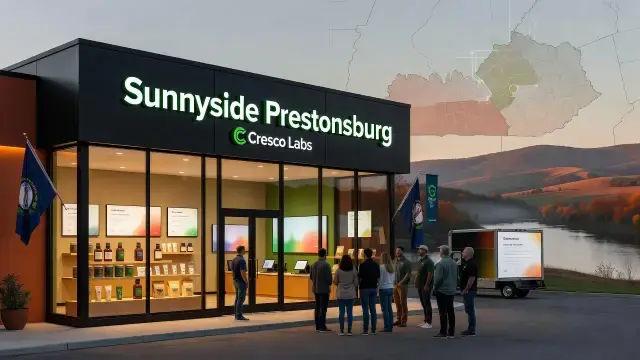
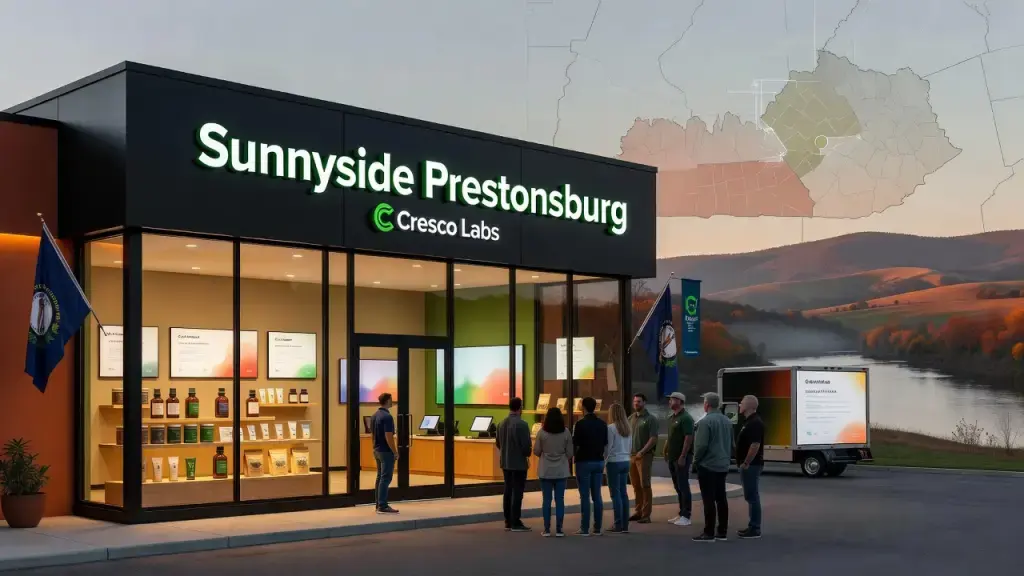
Cresco Labs has opened Sunnyside Prestonsburg, its 83rd dispensary nationally, giving Kentucky's medical cannabis program a presence in all 11 regions of the Commonwealth for the first time. The store sits at 81 Glynview Plaza in Prestonsburg, squarely in Eastern Kentucky, a part of the state that has historically had thinner access to specialty retail and healthcare infrastructure generally.
Why Regional Coverage Matters More Than Store Count
Eighty-three locations is a notable scale milestone for a multistate operator. But the more consequential detail here is geographic, not numerical. Kentucky structured its program around regional distribution, and a medical cannabis market only functions if registered patients can reasonably reach a licensed dispensary without crossing half the state. Rural access gaps are a recurring problem in newly launched medical programs - patients in remote counties often default to unregulated sources or simply forgo treatment options altogether when the nearest storefront is hours away. Completing coverage across all 11 regions removes that excuse, at least on paper, and puts pressure on the state's remaining build-out to focus on density rather than geography.
The Operational Reality Behind a "Grand Opening"
A new dispensary opening isn't just flipping a sign. It means a completed buildout that passed state inspection, a verified seed-to-sale tracking integration, point-of-sale systems configured for Kentucky's patient registry checks, and a curated product menu stocked with lab-tested batches carrying valid certificates of analysis. Every SKU on that shelf - flower, tinctures, topicals, edibles - has to trace back through compliant packaging and testing records before it ever reaches a Wellness Advisor's counter. For a multistate operator like Cresco, replicating that compliance stack in a new jurisdiction, under a new regulatory framework, is the unglamorous work that actually determines whether an opening date holds.
What This Signals for Other Operators and Suppliers
Kentucky's program is still young, and young medical markets tend to reward operators who move early on infrastructure rather than storefront count alone. For wholesalers and brand partners eyeing Kentucky, full regional dispensary coverage is a meaningful signal - it suggests distribution logistics, delivery manifests, and retail demand are starting to normalize statewide rather than clustering around a handful of urban centers. Landlords evaluating cannabis retail tenants in secondary and rural markets, meanwhile, get a data point suggesting access-driven buildout is still the operative strategy for multistate operators here, ahead of any assumption that adult-use expansion drives near-term decisions.
Access Is Not the Same as Affordability or Safety Assurance
Expanded geographic access addresses one barrier. It doesn't resolve others - pricing, insurance exclusion common to cannabis programs generally, or the ongoing need for consistent lab testing enforcement as more product volume moves through a wider retail footprint. Registered patients purchasing in-store or online for pickup should still expect age and registry verification at point of sale, consistent with Kentucky's medical program requirements. As the state's dispensary network fills in, regulators and operators alike will face the next-stage question: not whether stores exist in a region, but whether testing, labeling, and inventory compliance keep pace as throughput increases.