The bipartisan marijuana banking bill has been going nowhere for months - no floor votes scheduled, no active negotiations, barely a conversation. But President Donald Trump's executive order directing federal agencies to move cannabis from Schedule I to Schedule III of the Controlled Substances Act may have just changed the political arithmetic in ways that matter. Sen. Bernie Moreno (R-OH), who is expected to sponsor the Secure and Fair Enforcement Regulation (SAFER) Banking Act in the Senate, says the rescheduling move "changes it big time" for the legislation's chances of passage.
A Bill on Pause, a Congress Buried in Other Business
Moreno was candid about where things stand right now. Asked whether there have been recent discussions about advancing the bill, his answer was blunt: "No." He had earlier suggested the fall as a possible window, but fall is nearly over and Congress is occupied with spending negotiations and health care subsidy extensions. "The line is deep in terms of getting stuff done," he said.
That's the honest Beltway arithmetic. The SAFER Banking Act is far from universally embraced among Republican lawmakers, and leadership has shown little appetite for scheduling floor time on cannabis legislation when the party's governing agenda is already stretched thin. The House has passed versions of the bill seven times over recent sessions; in the Senate, it cleared committee last Congress but never reached a floor vote. That pattern - committee approval, floor silence - has become the bill's signature trajectory.
Still, the machinery hasn't stopped entirely. A Senate Banking subcommittee convened days before the White House confirmed the rescheduling order, taking testimony specifically on banking access issues, including the challenges facing state-licensed cannabis businesses operating under federal prohibition. Sen. Thom Tillis (R-NC), the subcommittee chair and something of an outlier among his GOP colleagues on cannabis policy, said he "absolutely" agreed the banking issue needs to be addressed. Separately, Rep. Warren Davidson (R-OH) raised the cannabis banking problem with Comptroller Jonathan Gould at a House Financial Services Committee meeting roughly two weeks prior. The signal from those hearings: the issue isn't dead, it's just waiting.
What Rescheduling Actually Does - and Doesn't Do
Here's what the executive order does not do: legalize marijuana. Moving cannabis to Schedule III keeps it a controlled substance. Federal prohibition remains in place. A state-licensed dispensary in Ohio or Colorado is still, technically, operating in conflict with federal law. That's the central reason so many banks and credit unions have refused to service cannabis businesses - the legal exposure, however attenuated in practice, is real.
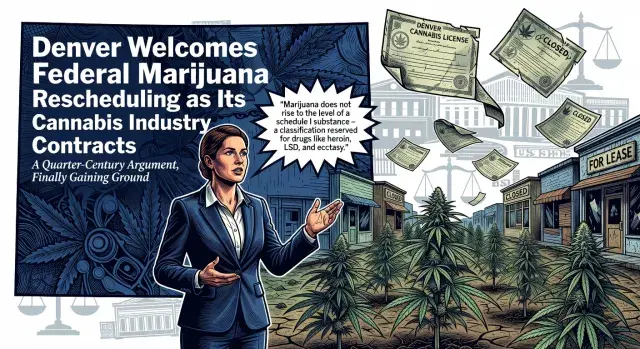
What the order does accomplish is more symbolic than structural, though symbolism in federal drug policy carries downstream weight. Schedule III status recognizes that cannabis holds medical value, a classification shift the Schedule I designation has long denied. It also unlocks federal tax deductions under Section 280E of the Internal Revenue Code - a provision that has functionally penalized cannabis businesses by disallowing standard business expense deductions available to every other legal industry. And it loosens certain research restrictions that have historically made clinical cannabis studies more difficult to conduct.
More to the political point: it gives Republicans who are on the fence about the banking bill a reason to move. Moreno himself, before the order was confirmed, described rescheduling as an "important domino" in the push for SAFER Banking. The logic isn't hard to follow - if the federal government formally acknowledges cannabis has medical value, the argument that banks should be kept entirely out of the cannabis sector becomes harder to sustain with a straight face.
Where Republican Skeptics Stand
Not everyone is persuaded that rescheduling changes the banking calculus. Sen. Steve Daines (R-MT), who has led GOP sponsorship of the banking bill in past sessions, said he's "not sure absolutely" that moving marijuana to Schedule III would meaningfully shift how colleagues approach the legislation. His read: "Many senators hold strong opinions, and they keep those opinions separate from SAFE Banking."
That's a meaningful counterpoint. The banking bill's Republican critics have generally framed their opposition in terms of federal law coherence - the argument Rep. Andy Harris (R-MD) made plainly: "if it's illegal at the federal level, it should be kept out of the banking system." For those members, Schedule III doesn't resolve the underlying federal illegality problem; it just rearranges it. The plant remains prohibited, and the banking risk doesn't disappear with a reclassification.
On the Democratic side, Sen. Ron Wyden (D-OR) holds a more optimistic view, arguing that rescheduling sends a "huge message" to colleagues about the need to modernize federal marijuana law. The bipartisan coalition behind the bill has always been genuine; the disagreement is less about whether the bill is worth passing and more about whether this particular Congress, at this particular moment, has the bandwidth and the will to take it up.
The Practical Stakes for an Industry Running on Cash
The underlying problem is unglamorous but serious. Cannabis businesses in states where the plant is legal operate in a precarious financial environment - forced to handle large volumes of cash, unable to access standard commercial banking services, locked out of payment processing infrastructure that any ordinary retail business takes for granted. Some banks and credit unions have accepted cannabis clients by following Obama-era reporting guidelines designed to mitigate federal enforcement risk, but that approach remains a calculated gamble, not a safe harbor.
The result is a fragmented, cash-heavy industry with real public safety implications: cash-intensive businesses attract theft, complicate tax enforcement, and make financial transparency harder to maintain. None of that gets resolved without legislative action. Rescheduling alone won't open bank doors - federal banking regulators still operate under statutes that treat cannabis businesses as legally compromised clients. Only Congress can change that.
Whether this Congress does remains an open question. The executive order has given the bill's supporters something to work with. Whether that's enough to move it out of the queue is something no one in Washington, at the moment, seems ready to predict with confidence.