Regulated cannabis retail is no longer in its early-adopter phase, and the operational pressures that come with a maturing market are becoming impossible to ignore. From seed-to-sale tracking failures to inventory discrepancies that trigger state audits, licensed dispensary operators across adult-use and medical markets are discovering that the gap between a working compliance system and a merely adequate one carries real financial consequences. The question facing most operators today is not whether to invest in better infrastructure - it is whether they waited too long.
Seed-to-sale tracking sits at the center of most compliance obligations. State regulators in markets like Maryland, Michigan, Colorado, and Illinois mandate that every product unit moving through the supply chain - from cultivation to wholesale transfer to retail sale - be logged in a state-designated system, most commonly METRC. Dispensary owners who rely on manual workarounds or disconnected point-of-sale systems run a compounding risk: discrepancies accumulate quietly until an audit surfaces them all at once. Operators looking for a tighter integration between their daily retail workflow and state reporting have, in some markets, turned to purpose-built solutions - a Metrc-compliant POS for Maryland, for instance, reduces the manual reconciliation burden that otherwise falls on store managers at the end of every shift.
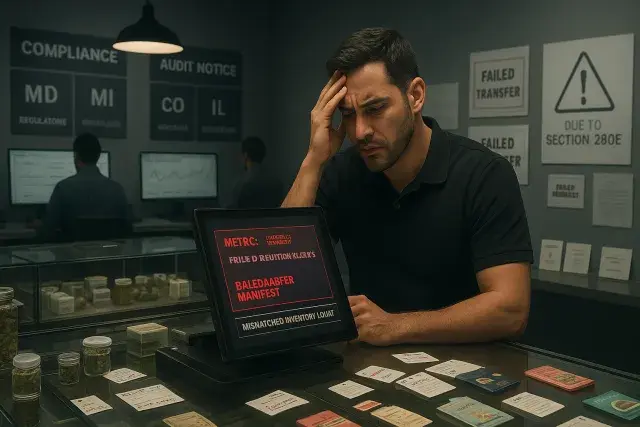
Here is the catch that many multi-location operators underestimate. METRC compliance is not a one-time configuration. It requires ongoing staff training, regular software updates as state reporting requirements change, and internal audits to catch tagging errors before they become license-level violations. A single mislabeled product batch - wrong weight entry, incorrect package tag, failed transfer manifest - can flag a dispensary for a compliance review. In states where license caps are in place, that kind of regulatory scrutiny carries outsized risk, because a license placed under a corrective action plan is difficult to defend when ownership groups are also trying to raise capital or close acquisitions.
Inventory Management Remains a Persistent Weak Point
Inventory shrinkage in cannabis retail is a problem with multiple origins - theft, mislabeling, vendor short-packs, and system entry errors all contribute. What is striking, though, is how often the root cause traces back to point-of-sale data that does not reconcile cleanly with METRC. When a budtender voids a transaction manually instead of processing it through the POS correctly, or when a product is returned without a corresponding inventory adjustment, the variance accumulates. Over weeks, those small variances become audit findings.
Dispensary operators managing higher SKU counts - shops carrying fifty or more active product lines across flower, concentrates, edibles, and topicals - face the sharpest version of this problem. Each category may carry its own batch tracking requirements, unit-of-measure conventions, and packaging compliance specifications. Managing that through a generic retail POS not built for cannabis is, to put it plainly, a setup for compliance exposure. The operational cost of a corrective audit almost always exceeds the cost of the right software.
Tax Exposure Under 280E Adds Urgency to Accurate Record-Keeping
Federal tax code Section 280E remains in effect for cannabis businesses operating in Schedule I status - and that means dispensary operators cannot deduct ordinary business expenses the way a conventional retailer can. The only deductions available are costs of goods sold. That restriction makes precise inventory costing critically important. If a dispensary's METRC records and internal accounting do not align, operators risk overstating deductible COGS - which, under IRS scrutiny, creates a tax liability problem on top of any state compliance issue.
Most cannabis CPAs will tell you the same thing: clean, timestamped inventory records that match the state tracking system are the foundation of a defensible tax position. Sloppy seed-to-sale data is not just a regulatory problem. It reaches directly into the tax bill.
What Operators Should Be Asking of Their Technology Vendors
The vendor conversation in cannabis retail has matured alongside the market. Early dispensary operators often selected POS systems based on price or basic functionality. The more useful questions now are whether the system maintains a live two-way sync with METRC, how it handles failed API calls to the state system, what the error-logging process looks like, and whether the vendor has an active compliance support team that monitors regulatory changes by state.
Operators running multiple doors - whether in a single state or across a multi-state footprint - also need to ask how the platform handles inter-facility transfers and wholesale transactions. A retail-only POS that cannot manage a transfer manifest cleanly creates a documentation gap the moment product moves between a dispensary and an adjacent delivery operation or sister store.
The technology infrastructure question is, ultimately, a risk management question. Compliant operations retain their licenses, attract institutional investment, and build the kind of audit record that supports future license applications in competitive markets. That is not abstract. In regulated cannabis retail, the compliance log is part of the business asset.