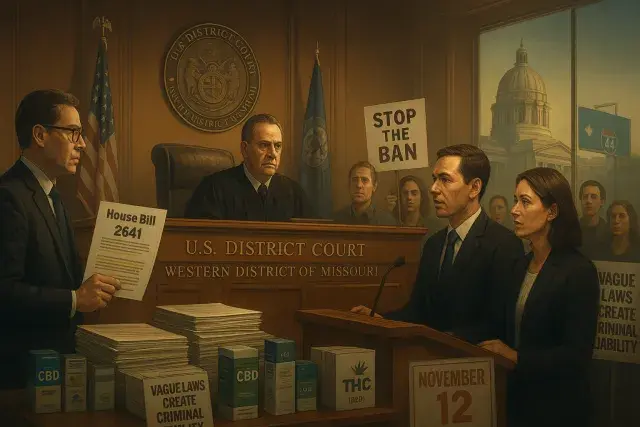
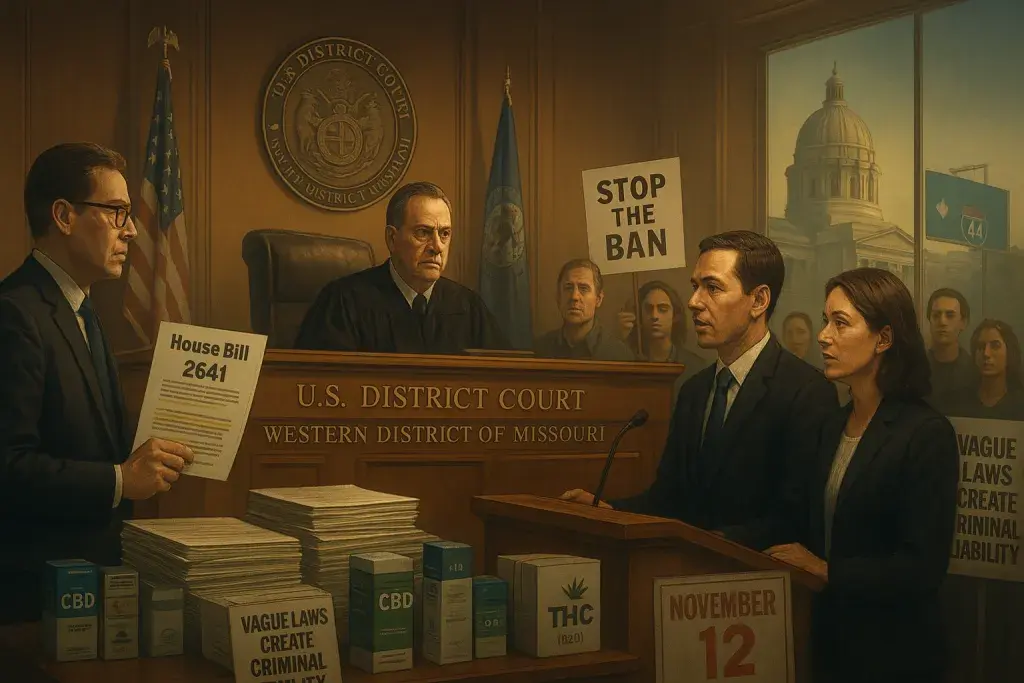
A coalition of Missouri and Wisconsin hemp businesses filed a federal lawsuit Thursday challenging a state law that would pull intoxicating hemp products from shelves across Missouri starting November 12. The complaint, filed in the U.S. District Court for the Western District, argues that the legislation - House Bill 2641, signed by Gov. Mike Kehoe earlier this year - contains definitions so contradictory and vague that businesses, law enforcement, and prosecutors cannot determine what is actually legal to sell, transport, or possess.
The plaintiffs include MNG 2005, Inc., the St. Louis-based parent company of 55 CBD Kratom retail locations nationwide, the Missouri Hemp Trade Association, and Lifted Liquids Inc., a Wisconsin-based hemp manufacturer. Their core argument: the bill simultaneously classifies the same products as both "hemp" and "marijuana" in different provisions, creating compliance exposure that carries criminal consequences under Missouri law. For multi-location operators managing inventory compliance across dozens of storefronts - the kind of businesses that depend on clearly defined product classifications to build their SKU menus, purchasing decisions, and labeling protocols - that kind of statutory contradiction is not a technicality. It's an operational emergency. Compliance teams at retailers who use their platform to track inventory and maintain audit-ready records know that when the legal definition of a product shifts mid-season, every purchase order, product batch, and compliance log tied to that SKU becomes a liability question overnight.
The bill also restricts who may transport hemp products through Missouri - even in transit - which the coalition says conflicts with federal protections for interstate hemp commerce. And its effective date provisions, the lawsuit contends, are "so convoluted that businesses cannot determine which products are covered or when." That's not regulatory complexity operators can work around with a software update. It's the kind of statutory ambiguity that invites inconsistent enforcement and, in the worst case, criminal exposure for licensed business owners acting in good faith.
What the Law Actually Does - and What It Leaves Unanswered
HB2641 effectively mirrors the federal hemp ban that Congress approved last year, pulling intoxicating hemp-derived products - including THC seltzers currently sold in bars and grocery stores - off Missouri shelves by mid-November. If Congress reverses course and permits those products federally, Missouri would restrict sales to licensed marijuana dispensaries only. If Congress delays its own ban, Missouri would still prohibit all intoxicating hemp products except intoxicating beverages.
Here's the catch: that tiered structure requires businesses to monitor and respond to federal legislative timelines they cannot control, while simultaneously operating under a state framework that the lawsuit argues fails to define its own terms with legal precision. Craig Katz, government relations and compliance manager for MNG 2005, put it plainly - legislators who don't fully understand the technical distinctions between hemp and marijuana chemistry are producing law that doesn't hold together under scrutiny.
The coalition also warns that the bill's vague definitions could reach beyond intoxicating products. Non-intoxicating CBD products - a much larger and more established segment of the hemp retail market - may also end up swept off Missouri shelves as a consequence of definitions that weren't drawn carefully enough to exclude them.
A Criminal Compliance Problem, Not Just a Business Dispute
What makes this lawsuit structurally different from a typical business challenge to new regulation is the criminal dimension. Unlike most cannabis retail compliance disputes, which play out through licensing boards, administrative penalties, or tax enforcement, this one involves criminal statutes. Unlicensed marijuana activity is a crime in Missouri. If HB2641 classifies certain hemp products as marijuana under one provision while treating them as hemp under another, a retailer stocking those products in good faith could be exposed to criminal prosecution - not just a fine or a license suspension.
That framing matters for the lawsuit's constitutional argument. Vagueness challenges succeed when a law fails to give ordinary people fair notice of what conduct is prohibited, and when it invites arbitrary or discriminatory enforcement. The coalition's legal theory is that HB2641 does both. The bill's sponsor, Rep. Dave Hinman, is skeptical. He described the lawsuit as a last-ditch effort and expressed confidence the legislation would survive - noting it passed both chambers and was signed by the governor after a full legislative process.
The Broader Market Implication
Missouri is not alone. Legislatures across the country have been wrestling with how to regulate intoxicating hemp products since the 2018 Farm Bill created a legal gray zone that neither Congress nor states anticipated. Products with significant THC concentrations - the lawsuit notes some currently sold in Missouri smoke shops contain as much as 1,000 mg of THC - entered retail channels outside the licensed marijuana dispensary system, undercutting dispensary operators who carry significant regulatory and tax burdens to sell cannabis legally.
That tension is real. Licensed dispensary operators have consistently argued that unregulated hemp-derived THC products compete directly with their inventory without facing equivalent compliance costs, testing requirements, or excise taxes. From that perspective, legislation like HB2641 levels the playing field. Jay Patel, president of the Missouri Hemp Trade Association, sees it differently - calling the bill "the elimination of an entire legal industry coupled with a government-mandated monopoly." Both descriptions contain some truth, depending on where you sit in the supply chain.
What's striking here is how much turns on definitions. In cannabis retail, the difference between "hemp" and "marijuana" under state law determines which agency regulates a product, which testing protocols apply, which licenses are required, how it's taxed, and whether selling it is a misdemeanor or a felony. Getting those definitions wrong in statute doesn't just create business uncertainty - it creates a compliance framework no operator can reliably follow. That problem won't resolve itself by November 12.