
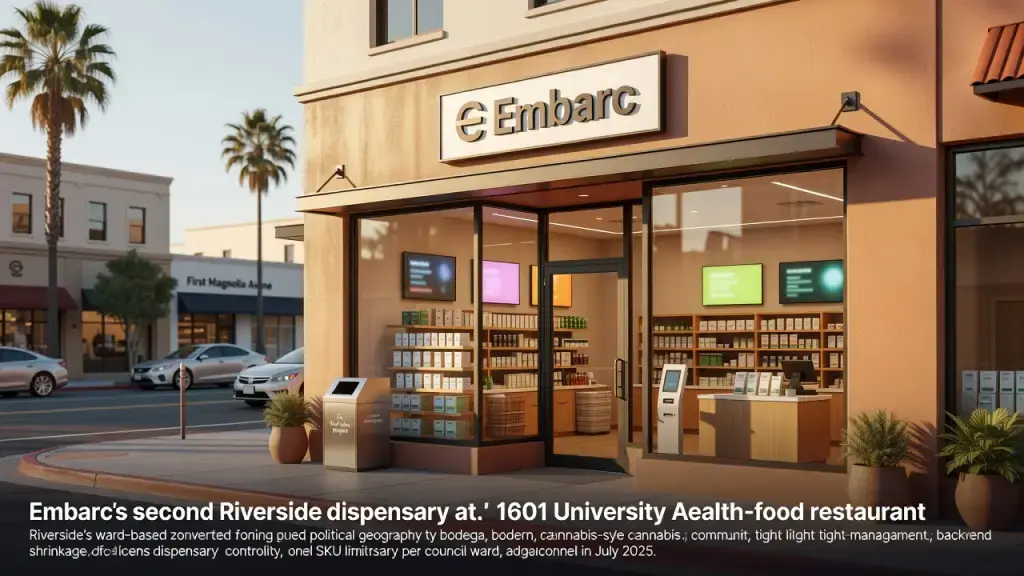
Embarc opened its second Riverside dispensary on Monday, July 13, at 1601 University Ave., following the March debut of its first store on Magnolia Avenue. The two locations exist because of a specific zoning choice: Riverside caps licensed cannabis retail at one dispensary per council ward, a rule the City Council adopted in July 2025 after years of moratoriums and competing proposals. That cap, more than consumer demand or site economics, is what determined where Embarc could and couldn't plant a flag.
What a one-per-ward cap actually does
Ward-based license caps are a familiar tool in cities wary of cannabis retail clustering - the same instinct that's long shaped liquor-license distribution in municipal zoning codes. The mechanism is straightforward: instead of a citywide numerical cap that lets operators compete for density in whichever commercial corridor pencils out best, the city spreads access across its political geography. For operators, that means site selection isn't just about traffic counts, parking, or rent. It's about which ward a parcel sits in, whether that ward's one slot is open, and whether a landlord with cannabis-friendly zoning is willing to sign a lease before entitlements are locked down. Embarc's University Avenue site, previously a health-food restaurant, came together partly through a personal connection to the property owner - a reminder that in capped markets, real estate relationships can matter as much as capital.
Retail format as a compliance and operations choice
Embarc describes its store layout as "bodega-style" - open shelving, self-guided browsing, baskets instead of a counter transaction model. That's a design decision with operational consequences. Open-shelf retail requires tighter SKU management and more frequent reconciliation against seed-to-sale tracking systems like METRC, since products are handled and compared by customers rather than retrieved by staff on request. It also raises the stakes on inventory shrinkage controls and point-of-sale accuracy, since budroom staff - Embarc calls them "guides" - are managing a browsing environment rather than a transactional queue. None of that is visible to a customer grabbing a basket, but it's the backend discipline that keeps a self-service floor plan compliant with state tracking and local licensing requirements.
The community-fund model, and why the payout timeline matters
Embarc commits 1% of sales at each location to a community giveback fund, administered through a local advisory board rather than disbursed directly by corporate staff. Riverside's fund has been accruing since Magnolia's opening in March but hasn't paid out yet; Embarc says it's in talks with local organizations and expects first donations in August. That lag is worth noting for other operators watching how social-equity and community-benefit commitments get structured in new adult-use markets: a percentage-of-sales pledge is only as credible as the governance behind it, and routing decisions through a board rather than a marketing calendar is one way operators try to avoid the appearance of giveback-as-publicity.
Consumer-facing basics
The University Avenue store operates under the same regulatory guardrails as any licensed California adult-use dispensary - age verification at entry, lab-tested products with compliant packaging and batch-level traceability, and state excise tax applied at the point of sale. Operators entering ward-capped or otherwise limited markets should expect scrutiny on all of it, since a smaller number of licensed storefronts per city tends to mean each one draws more attention, both from regulators and from neighbors still forming a view of what licensed retail looks like on their block.