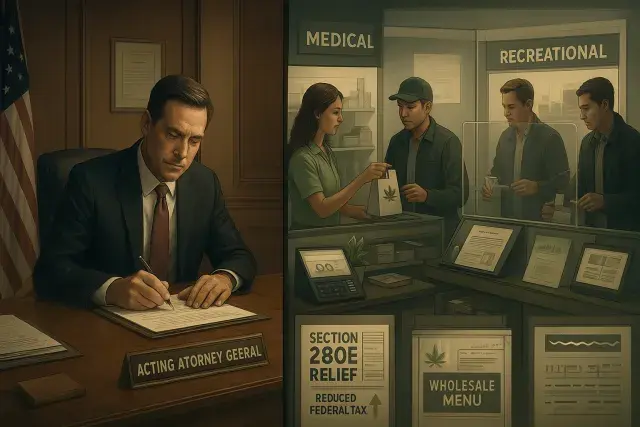
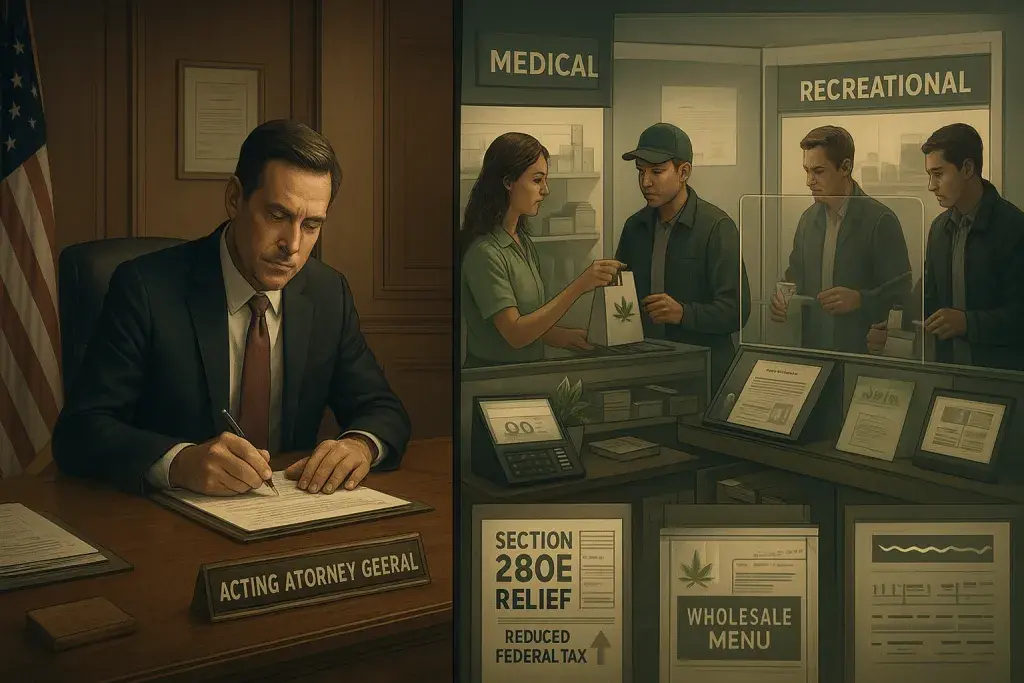
Acting Attorney General Todd Blanche signed an order Thursday moving state-licensed medical marijuana from Schedule I to Schedule III under the Controlled Substances Act - a regulatory shift that directly affects taxation, research access, and federal standing for thousands of licensed cannabis businesses across the country. The order does not legalize marijuana under federal law. But for operators who have spent years absorbing punishing tax bills and operating in a legal gray zone, the practical consequences are substantial.
The most immediate financial impact lands on Section 280E of the Internal Revenue Code. Under Schedule I classification, cannabis businesses have been prohibited from deducting ordinary business expenses on federal taxes - payroll, rent, utilities, marketing - because federal law considered them traffickers in a controlled substance with no accepted medical use. That prohibition has compressed margins at dispensaries of every size, from single-location independents to multi-state operators running dozens of stores. Operators in states like Maine, where licensed medical programs have operated alongside adult-use retail for years, have had to build entirely separate accounting structures to manage the 280E burden. Platforms like a cannabis dispensary pos system maine operators use for seed-to-sale tracking and compliance reporting will likely need configuration updates as the tax treatment of medical sales shifts under the new classification. Schedule III status allows companies to deduct standard business expenses, which means a meaningful reduction in effective federal tax rates for qualifying medical marijuana operators - and a corresponding improvement to bottom-line cash flow.
Blanche's order also sets up an expedited DEA registration process for state-licensed medical marijuana producers and distributors. That matters for supply chain compliance. Currently, many licensed operators exist in a regulatory space where their state licenses are robust and their compliance logs are meticulous - seed-to-sale tracking, COAs on every product batch, compliant packaging, age verification at every POS terminal - but their federal standing has been effectively nonexistent. The new registration pathway doesn't hand operators a federal license to operate, but it does formalize the federal government's recognition of state-licensed programs in a way that hasn't existed before.
What the Order Actually Changes - and What It Doesn't
Here's the catch operators need to understand clearly: the rescheduling applies specifically to marijuana distributed through state-licensed medical programs. Cannabis products sold outside those systems - including, in many states, adult-use recreational sales at the same dispensary counter - remain Schedule I under this order. That creates a compliance and accounting bifurcation that operators in dual-license markets will need to manage carefully.
Washington state, for example, has hundreds of licensed stores carrying medical endorsements alongside their adult-use operations. In states like that, a single dispensary may now be handling Schedule III product for registered medical patients and Schedule I product for adult-use customers - potentially processed through the same inventory system, the same POS terminals, the same back-office accounting software. That distinction will need to be tracked and documented with precision. Wholesale menus, product batches, and delivery manifests may need to be coded differently depending on how product enters the dispensary's supply chain and under which program it's dispensed.
The order also makes explicit that cannabis researchers won't face federal penalties for obtaining state-licensed marijuana or marijuana-derived products for study. That's a meaningful shift for the research side of the industry - and for companies developing cannabis-derived medicines that may one day pursue FDA approval, since any marijuana-derived medicine approved by FDA would similarly sit at Schedule III.
The 280E Relief Is Real, But Read the Fine Print
To put it plainly: 280E has been one of the single most damaging structural constraints on licensed cannabis retail economics. The inability to deduct ordinary business expenses has meant that profitable-looking dispensaries have paid effective federal tax rates far above what comparable retail businesses pay. For multi-state operators carrying significant overhead - store buildouts, licensed staff, seed-to-sale compliance systems, insurance - the tax exposure has been severe.
Schedule III classification removes that prohibition for state-licensed medical operations. What operators should not assume, however, is that the transition is automatic or administratively simple. Tax counsel familiar with cannabis business structure will need to assess how existing corporate entities are organized, which revenue streams qualify under the new classification, and how the DEA registration process intersects with current state license structures. Operators with vertically integrated businesses - cultivation, processing, and dispensary under one ownership structure - face additional complexity in separating which portions of their operations now qualify for different federal treatment.
The Trump administration has announced a broader administrative hearing process beginning in June to consider rescheduling marijuana more comprehensively. That process could eventually bring adult-use sales into a different regulatory category - or it could stall. Operators would be unwise to build forward financial models on the assumption that recreational cannabis follows the same path on any particular timeline.
Political Headwinds and an Uncertain Road Ahead
The order arrived through a procedural path that sidestepped the formal DEA review process - Blanche relied on a provision allowing the attorney general to classify drugs the U.S. must regulate under international treaty obligations. That approach moved faster than the administrative review Biden's Justice Department had initiated, which had generated tens of thousands of public comments and remained unresolved when the administration changed in January. Whether that procedural shortcut holds up to legal challenge is a genuine open question.
Opposition within the Republican Party is real. More than 20 Republican senators - some of them closely aligned with Trump - signed a letter last year urging the administration to maintain Schedule I status. The political support for this order is not unanimous, and the broader rescheduling review process beginning in June will draw that opposition back into the conversation.
What's striking here is that the most durable wins for licensed operators aren't contingent on any further political movement. The 280E relief for medical operations, the DEA registration pathway, and the research access provisions take effect under the current order. For a sector that has operated under sustained federal uncertainty since California first authorized medical cannabis in 1996, that's a concrete shift - not a promise of one.