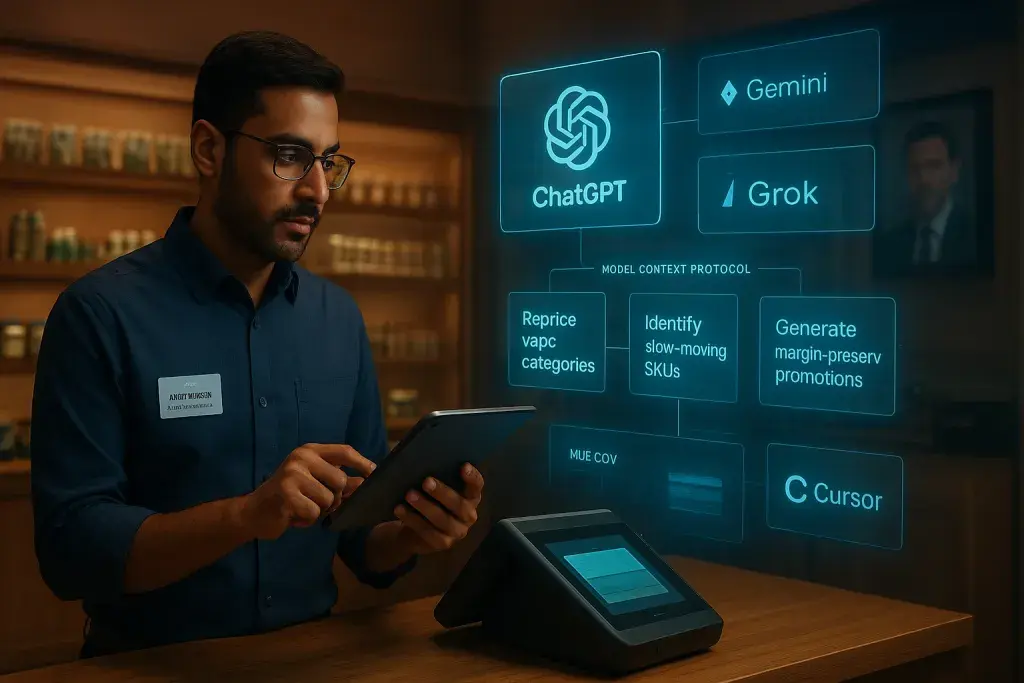
Flowhub has launched an MCP connector that lets dispensary operators issue natural-language commands - through ChatGPT, Claude, Gemini, Grok, Perplexity, or Cursor - that execute real changes inside their Flowhub accounts. The product, called Flowhub MCP, is built on the Model Context Protocol, an open standard designed to let AI tools communicate with external software systems. For cannabis retailers already buried under compliance recordkeeping, SKU management, and inventory reconciliation, the pitch is straightforward: stop switching tabs and start having conversations with your data.
The operational stakes here are worth spelling out. Running a licensed cannabis retail store isn't like running most other retail businesses. Operators must maintain real-time inventory accuracy for seed-to-sale tracking systems, reconcile sales data against state compliance platforms, manage pricing carefully to preserve margins against excise tax obligations, and keep audit trails that regulators can examine. A misconfigured price change or an undocumented inventory transfer isn't just a business problem - it can trigger a compliance violation. Any cannabis POS platform carrying this kind of workflow responsibility has to balance flexibility with accountability, which is exactly why Flowhub MCP requires operator approval before any AI-initiated change is applied.
The distinction Flowhub is drawing matters: this isn't a reporting dashboard or a chat interface that summarizes what happened. The connector is designed to act - repricing an entire vape category, moving inventory from the vault to the sales floor, identifying slow-moving SKUs and generating deals that preserve a specified margin threshold. Those are tasks that typically require a manager to log into a POS system, pull reports, cross-reference wholesale cost data, and manually enter changes. Compressing that process into a natural-language prompt doesn't just save time; it changes who in a dispensary can actually make those decisions without specialized software training.
Why the Open Protocol Approach Is the Strategic Bet Here
Flowhub isn't shipping a proprietary AI assistant. That choice is deliberate. The Model Context Protocol is an open standard, which means any compliant AI tool can connect to an MCP-enabled system without custom integration work for each new model. Kyle Sherman, Flowhub's founder and CEO, framed it plainly in the announcement: the best AI available in 2026 won't hold that position two years from now. Building a closed, branded AI layer inside the product would lock customers into Flowhub's model choices - which is the opposite of the platform-agnostic positioning Flowhub has been building toward through its open API strategy.
This is consistent with a broader pattern in regulated retail software. Operators in cannabis have historically been burned by vendor lock-in: proprietary systems that control data exports, charge for API access, or restrict integrations with competing tools. For multi-state operators managing different compliance environments across state lines, that inflexibility has real costs. Flowhub's unified commerce schema - which ties together POS, payments, ecommerce, inventory, loyalty, and compliance reporting - becomes more valuable if operators can connect it to the AI infrastructure they already trust, rather than being funneled toward one the vendor prefers.
What Early Adoption Actually Looks Like on the Floor
Ankit Bhasin, owner of Cannabis Cowboy, offered a ground-level account of the connector in practice. He described using Claude connected through MCP to surface actionable recommendations from existing store data - and to generate suggested promotions daily. His framing cuts to the commercial reality: in adult-use retail, product differentiation is limited. Operators across a given market largely carry the same licensed brands, the same top-selling categories, the same SKU mix their distributor relationships allow. Operational efficiency and customer experience end up being the primary competitive levers. If AI tooling can compress the time a store manager spends on administrative analysis, that's headcount time redirected toward the floor - or toward decisions that actually affect sales.
The audit trail requirement is worth a second look from a compliance standpoint. Cannabis regulators in most adult-use and medical states require documented records of inventory movements, pricing changes, and sales transactions. Any system that touches those records - automated or not - needs to produce a log that can satisfy a regulator's request during an inspection or audit. Flowhub's stated approach, holding changes in a pending state until an operator approves them, provides a human checkpoint. That's the right architecture for a regulated environment; it means the operator remains the responsible party of record, even when the workflow was initiated by a language model.
Implications for Cannabis Retail Technology Broadly
Flowhub processing more than $4 billion in annual cannabis sales gives it a meaningful data position - and a meaningful incentive to make that data actionable beyond standard reporting. The MCP launch signals something the broader cannabis software market will have to respond to: operators are going to start expecting their core platforms to be AI-addressable, not just AI-adjacent. Offering a dashboard with a few AI-generated insights is a different product from offering a protocol layer that lets any frontier model take action inside the system.
The thing is, cannabis retail technology has lagged general retail software in meaningful ways - partly because of banking restrictions under federal prohibition, partly because of the compliance overhead that diverts development resources, partly because the market fragmented early across too many state-specific systems. The window for platforms that can move fast on AI interoperability is open. Flowhub is moving through it. Whether competitors with deeper state compliance libraries or larger operator footprints follow through the same door, and how quickly, is the next question worth watching.