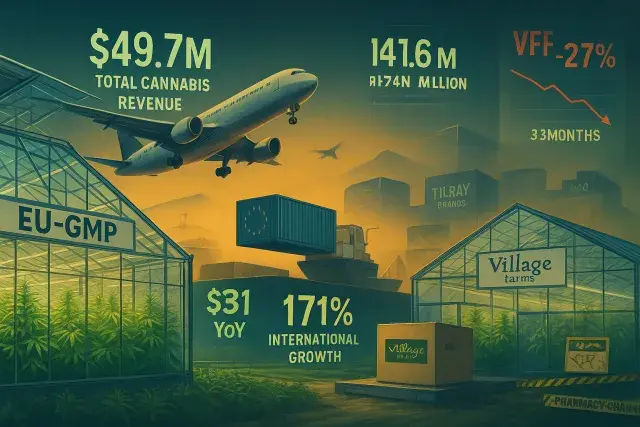
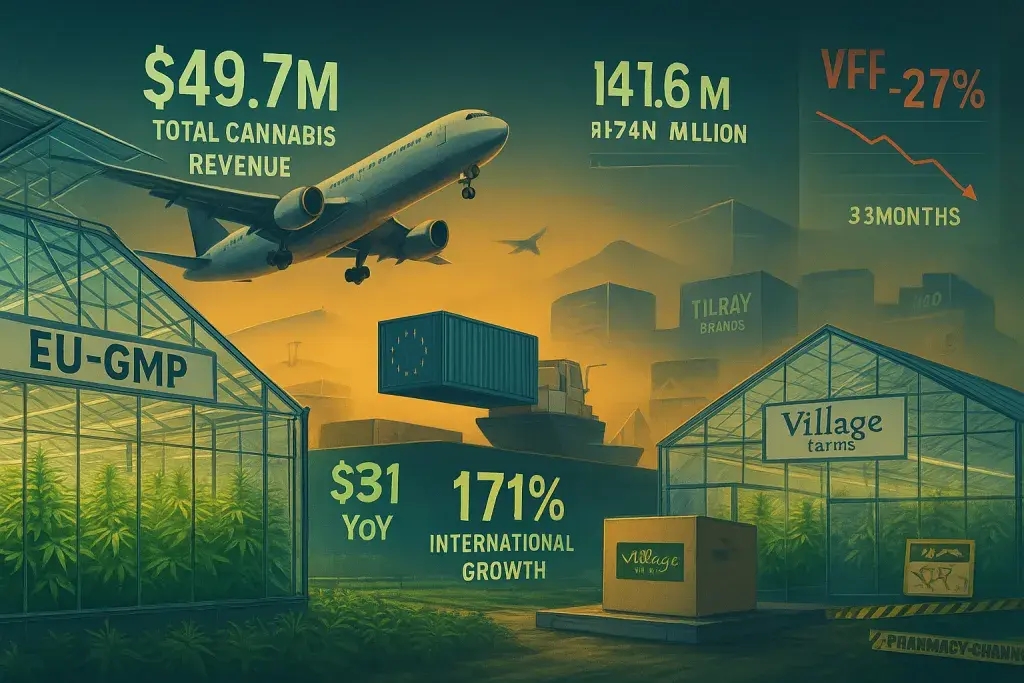
Village Farms International has done something genuinely difficult in cannabis: it grew revenue faster than analysts expected. Total cannabis sales climbed 27% year over year to $49.7 million in the first quarter of 2026, driven by a 171% surge in international export revenue to a record $14.6 million. And yet, shares of VFF have shed roughly 27% over the past three months. That gap between operational execution and market sentiment tells a story worth unpacking - one that matters not just to equity investors but to anyone tracking how the global medical cannabis supply chain is being rewired in real time.
The disconnect isn't hard to explain once you look past the headline numbers. Cannabis operators across every tier - from single-location dispensaries relying on cannabis POS for Minnesota dispensaries to track seed-to-sale compliance, to vertically integrated multinationals exporting EU-GMP-certified flower - all face the same structural reality: strong top-line growth rarely insulates a company from investor anxiety when the regulatory backdrop is murky and competitive pressure is building at the margin. Village Farms is a clear illustration. Its EU-GMP-certified production facilities - which management now describes as the world's largest of their kind - represent real capital investment and real operational capability. But capital markets are pricing in the risks that come after the capacity expansion, not just the capacity itself.
International Growth Is Real, and So Are Its Limits
The 448% increase in Netherlands sales and the momentum in Germany are not noise. Germany's regulated medical cannabis market has attracted serious commercial interest since its legislative reforms, and Village Farms has positioned itself to supply it with product that meets EU-GMP standards - a certification that functions, in practice, as the cannabis equivalent of pharmaceutical-grade compliance documentation. That credential matters because European regulators and pharmacy-channel distributors require it, effectively narrowing the pool of qualifying suppliers and giving certified producers a structural pricing advantage. For now.
Here's the catch: management itself acknowledged that pricing softness has begun to appear in the Netherlands as more licensed producers bring capacity online. That's the pattern the North American cannabis industry has watched play out in wholesale markets for years - rapid capacity expansion, followed by price compression, followed by margin erosion. The EU-GMP certification creates a barrier, but it isn't a ceiling on competition. Aurora Cannabis has made international medical cannabis the center of its commercial strategy, with active expansion in Germany, Australia, and Poland. Tilray Brands is building out its European medical platform through Tilray Medical and CC Pharma, and recently added HelloMD to its patient-access infrastructure in Canada. Village Farms is not alone in this space, and the market knows it.
What the Capacity Expansion Actually Signals
Since reporting first-quarter results, Village Farms has begun cultivation at its Phase II facility in the Netherlands and is advancing the Delta 2 greenhouse expansion in Canada. On paper, that's the right move for a company betting on sustained international demand growth. In practice, though, adding production volume into a market where pricing is already softening at the margin introduces execution risk that analysts are right to weigh carefully.
Wholesale pricing dynamics in cannabis are unforgiving. The North American experience - where years of licensed producer expansion drove wholesale flower prices down sharply in mature markets - serves as the relevant cautionary reference. EU markets are structurally different in some ways: pharmacy-channel distribution, medical-use framing, and stringent regulatory requirements all support pricing discipline that the adult-use retail shelf does not. But the mechanism is the same. More certified supply chasing relatively fixed near-term demand puts pressure on the price per gram, and that pressure flows directly through to gross margin.
The U.S. Optionality Question
Village Farms management has stated clearly that it views the United States as a significant long-term opportunity but intends to wait for greater regulatory clarity before moving aggressively. That's a defensible position - 280E tax exposure, state-by-state licensing complexity, and the persistent federal Schedule I classification make the U.S. market genuinely difficult to underwrite with confidence. But patience has a cost. Every quarter spent waiting is a quarter in which Aurora, Tilray, and a range of U.S.-based multistate operators are either deepening domestic infrastructure or positioning for the eventual federal shift. When that clarity does arrive, Village Farms will not be the only company with a plan.
Downward revisions to earnings estimates - the mechanism behind the Zacks Rank #4 (Sell) designation - reflect analyst skepticism about the near-term path to profitability rather than any dispute with the company's operational execution. Revenue growth is real. The EU-GMP certification advantage is real. The question analysts are asking is whether the margin structure can hold while two large greenhouse expansions are still ramping and European pricing is softening at the edges. That's not a question Village Farms can answer with a press release. It will be answered over the next several quarters in the gross margin line.
For licensed operators, investors, and supply chain professionals watching this space, Village Farms represents a legitimate test case for whether North American cannabis producers can build durable, export-driven businesses in regulated international markets - or whether the same competitive dynamics that pressured domestic wholesale will eventually follow them overseas.