SmartBud has built out distribution to 140 licensed dispensaries across New York, with its deepest shelf presence concentrated in New York City's five boroughs - Manhattan, Queens, Brooklyn, the Bronx, and Staten Island. That footprint matters less than what's happening inside the brand's category mix, where a single product type is carrying nearly the entire sales load.
A Flower-Dominant Portfolio, and What That Signals
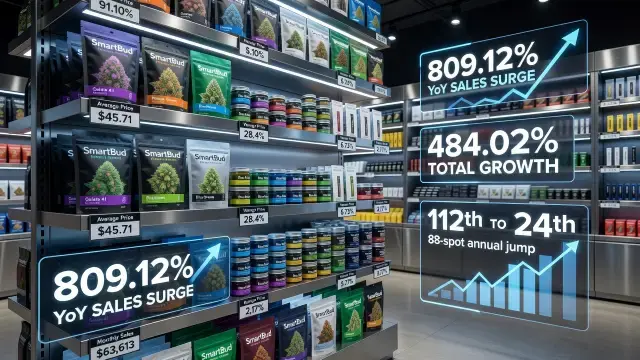
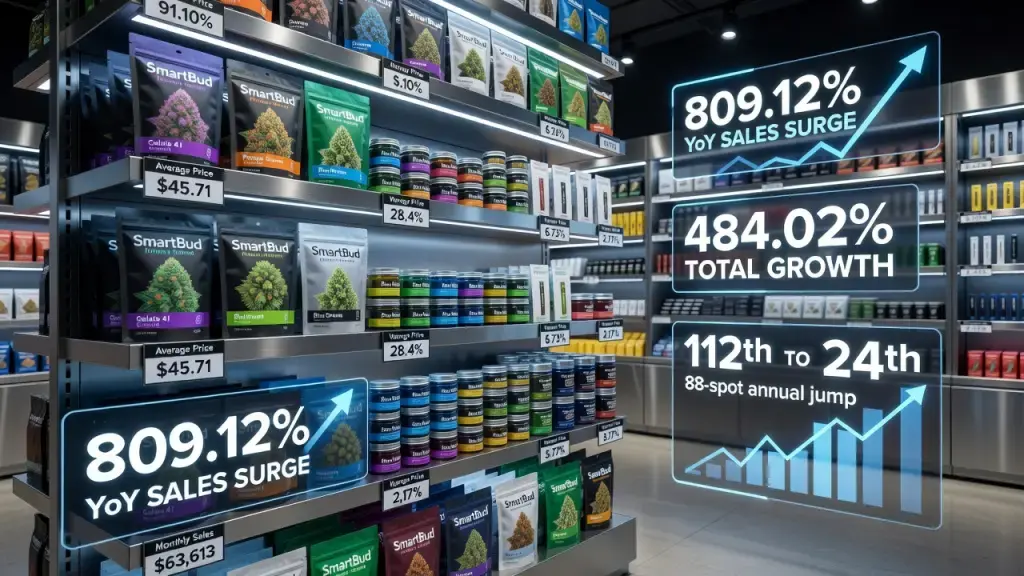
Flower accounts for 91.10% of SmartBud's category share in New York as of September 2026, ranking 24th in the state's Flower category. Sales in that segment jumped 809.12% year over year, though the month-over-month gain was a modest 1.87%. Pre-Roll, by contrast, holds just 6.73% share with a 5.25% YoY decline - but it posted a 19.13% MoM gain, suggesting some recent momentum even as the annual trend runs negative. Vapor Pens trail at 2.17% share, down 18.73% MoM with no prior-year comparison available. Put plainly: this is a brand that has concentrated almost all of its commercial weight into one format. That's not inherently a problem - plenty of cannabis brands build identity around a flagship category - but it does raise the question of how exposed SmartBud is if Flower demand cools or a competitor undercuts on wholesale pricing.
Pricing Tells Its Own Story
SmartBud's average Flower price sits at $45.71, well above the brand's blended average of $38.40, while Pre-Roll averages $12.34. That spread points to a premium-leaning Flower line paired with a lower-cost Pre-Roll tier functioning as an entry point for price-sensitive shoppers. The brand's overall average price is up 34.16% year over year, and total sales climbed 484.02% YoY - a combination that suggests SmartBud is not just moving more units, it's moving them at better margins. For dispensary buyers building budroom inventory and wholesale menus, that pricing posture matters: a brand pushing premium Flower needs consistent batch quality and lab testing results that hold up, since COA variability is one of the fastest ways to lose shelf trust with retail buyers.
Rank Movement Shows a Mixed Trajectory
SmartBud climbed 88 spots in New York Flower rankings over the past year, moving from 112th to 24th - a meaningful annual gain. But the more recent trend is less flattering: the brand peaked at rank 20 in June 2026 and has since slipped four places to rank 24 by September. Meanwhile, competitors are moving faster. Find. jumped from rank 5 to rank 1 with 16.16% YoY growth, and Grassroots advanced from 15th to 2nd on the back of 150.33% YoY sales growth. In practice, though, annual gains and recent quarterly direction tell two different stories. SmartBud's long-term trajectory is positive, but the three-month slide suggests share is being ceded to brands scaling faster right now - a dynamic that matters for retail buyers deciding which SKUs earn limited shelf space in a crowded New York Flower category.
SKU-Level Volatility Behind the Headline Numbers
Underneath the category trends, individual products are moving in sharply different directions. Super Sour Diesel (3.5g) fell 33.6% month over month, dropping to rank 9, while Dosido Pre-Ground (14g) declined 42.2% MoM and sits at rank 7 - a pullback that hints at fatigue in some legacy SKUs. Blue Dream (3.5g) moved the other way, rising 28.4% MoM to rank 4. Three of the top five SKU rankings belong to Flower formats, with Gelato 41 Ground (14g) leading at $63,613 in September sales and Papaya Ground (14g) close behind at rank 2.
- Larger ground Flower formats (14g) are outperforming smaller 3.5g packs in current demand
- Legacy strains showing double-digit MoM declines may need reformulation or repositioning on wholesale menus
- Pre-Roll's MoM gain, despite a negative YoY trend, suggests possible seasonal or promotional influence worth monitoring
For retail operators stocking SmartBud, the lesson isn't to chase every SKU shift - inventory shrinkage and shelf churn carry their own costs. It's to recognize that a brand's category-level success can mask real volatility at the product level, and purchasing decisions should weigh both.
What This Means for Buyers and Compliance Teams
None of these figures speak to product safety or potency claims, and dispensary staff should continue directing customers to each product's compliant packaging and lab-tested COA rather than sales rankings. Sales performance data, sourced through point-of-sale systems linked to Headset's reporting infrastructure, reflects market behavior - not quality or safety assurances. As with any seed-to-sale tracked inventory, retailers should cross-check batch-level testing before restocking high-velocity SKUs, particularly as demand patterns shift this quickly.