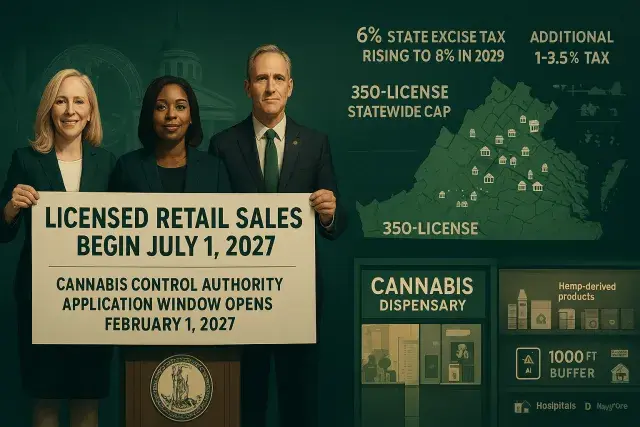
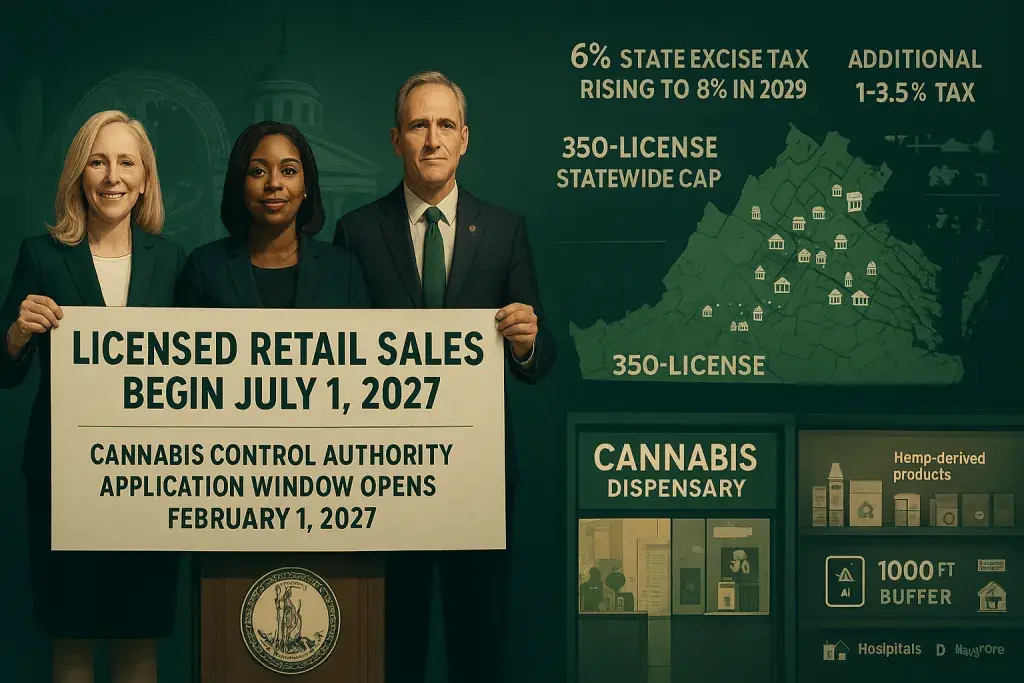
Virginia has a deal. Gov. Abigail Spanberger, state Sen. Lashrecse Aird, and Delegate Paul Krizek announced a budget compromise this week that would launch licensed adult-use retail cannabis sales on July 1, 2027 - completing a regulatory process that began when the state first moved to decriminalize possession in 2020. The Cannabis Control Authority would open its licensing application window on February 1, 2027, giving prospective operators a roughly five-month runway before stores are permitted to open. The deal still requires the state budget to be finalized, but the structural terms are now public and specific enough to start shaping operator strategy.
The Tax and License Structure Operators Need to Understand Now
The compromise sets a 6% state excise tax on cannabis products at launch, stepping up to 8% after July 1, 2029. Localities can stack an additional 1% to 3.5% local tax on top of that - plus the existing retail sales and use tax - which means the real tax burden on a retail transaction will vary meaningfully depending on where a store is located. For any operator doing margin math, this layered structure deserves close attention. Total effective tax rates in higher-tax localities will compress consumer-facing affordability and put additional pressure on wholesale pricing negotiations between retailers and cultivators. States that have launched adult-use markets with heavier tax loads - particularly early movers - have consistently seen illicit market competition persist longer than projected, which is precisely the problem Virginia's leadership says it wants to avoid. The 6% entry rate is a deliberate choice to keep legal prices competitive from day one. Operators evaluating site selection will want to model local tax variance as part of their real estate due diligence, not as an afterthought. Comparable frameworks in states with established adult-use markets - where point-of-sale systems must break out excise taxes separately at the register - show that robust POS infrastructure matters from the first transaction; operators researching technology benchmarks can look at how markets like Alaska have approached this, including resources covering the best cannabis pos systems alaska operators rely on for compliant tax calculation and inventory tracking.
A 350-License Cap Changes the Competitive Math
The compromise authorizes a maximum of 350 retail cannabis establishment licenses statewide. That's a hard ceiling - at least at launch. For context, Virginia is a large state with significant urban density in the Northern Virginia and Richmond corridors, plus substantial rural geography. Three hundred fifty licenses distributed across that footprint will create concentrated competition in high-traffic metro markets while leaving meaningful coverage gaps elsewhere. For investors and multi-location operators, the license cap makes early application positioning genuinely consequential. There is no indication yet of how licenses will be distributed geographically or whether social equity applicants will receive priority allocation, though the framing around small businesses and farmers in the governor's statement suggests those mechanisms are at least under discussion. Operators who have been waiting out Virginia's regulatory limbo should treat the February 1, 2027 application window as a hard deadline to build toward - not a soft target.
Hemp Regulation Closes a Loophole That Undercut Legal Operators
Here's the part that deserves more attention than it's getting. The compromise transfers regulation of industrial intoxicating hemp from the Virginia Department of Agriculture and Consumer Services to the Cannabis Control Authority, and specifically ends the so-called 25:1 hemp loophole - a provision from the previous administration that allowed high-THC hemp-derived products to be sold across Virginia with limited oversight. To put it plainly: that loophole meant that while licensed cannabis operators were building compliance infrastructure, paying licensing fees, and absorbing regulatory costs, a parallel market in hemp-derived intoxicants operated under far lighter rules. The consequences for licensed retailers are real. Unregulated products with comparable or higher potency than tested cannabis - but without the COA requirements, compliant packaging, or age-verification protocols that licensed dispensaries must meet - undermined the consumer safety rationale for the licensed market and made price competition structurally unfair. Bringing intoxicating hemp under CCA authority addresses that directly. It also signals that Virginia intends to use the CCA as a genuine regulatory body, not a permitting window.
Compliance Mechanics: ID Checks, Buffers, and What Repeated Failures Cost
The deal includes escalating penalties for failed ID checks - up to and including license revocation for repeated underage sales. Stores must be located no less than 1,000 feet from schools, hospitals, playgrounds, and drug treatment facilities. Both provisions are standard in adult-use frameworks, but the enforcement structure matters in practice. Escalating penalties with revocation as the terminal consequence mean that compliance training, point-of-sale ID verification workflows, and staff accountability protocols aren't optional overhead - they are license-preservation mechanisms. A single location's repeated failures can end the business. For operators building out store operations between now and the 2027 launch, compliance systems need to be designed into the store from the beginning: ID scan integrations at the POS, documented training logs, and management oversight of daily age-verification records. The 1,000-foot buffer from sensitive community locations will also affect real estate options in dense urban markets. Site evaluators will need to map those exclusion zones carefully before signing leases - particularly near hospital corridors in cities like Richmond or Arlington, where proximity to medical facilities could disqualify otherwise viable retail locations. Virginia's 2027 retail launch is not imminent, but the structural decisions being made now - site selection, license strategy, tax modeling, technology infrastructure, compliance design - will determine which operators are positioned to compete when the window opens.