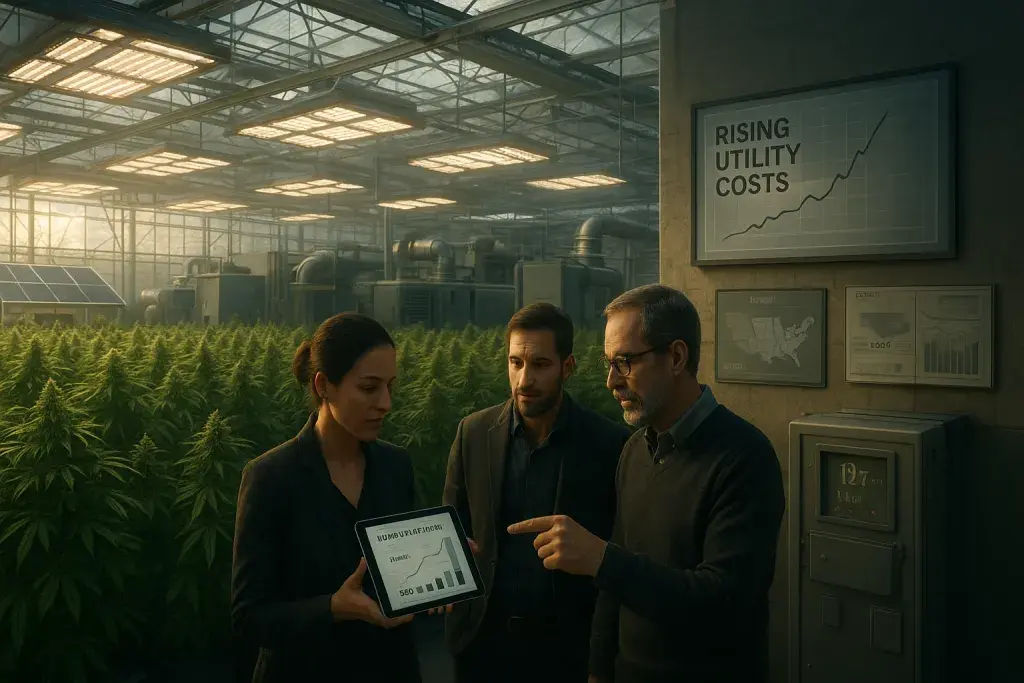
Indoor cannabis cultivation has always been an energy-intensive business. But the cost of running grow rooms nonstop - lights, HVAC, dehumidification, environmental controls - is accelerating at a pace that is outrunning the industry's ability to absorb it. For vertically integrated multistate operators, the numbers are no longer background noise. They're a structural threat.
Tiana Arriaga, vice president of product and marketing at Standard Wellness, a vertically integrated MSO with cultivation facilities in Missouri, Ohio, and Utah, has watched electricity costs climb between 8% and 12% over the past 16 months. Natural gas costs at the company have risen 46% over two years. These figures are compounding against an uncomfortable backdrop: price compression in mature markets like Missouri is real, and operators cannot pass input cost increases to consumers without losing them to the illicit market. Operators expanding into new states are tracking every fixed and variable cost with precision - the same discipline that drives demand for purpose-built tools like Minnesota seed-to-sale dispensary software, where tracking COGS at the facility level is baked into the compliance workflow from day one. The margin math, in short, does not work in cultivators' favor right now.
The national energy index rose 3.9% in May, following increases of 3.8% in April and 10.9% in March, according to the U.S. Bureau of Labor Statistics. Over the 12 months ended May 31, electricity costs rose 5.9%. And that number understates the pressure on cannabis operations specifically. Indoor cannabis grows consume approximately 50 times more power per square foot than an office building, according to Paul Shagawat, co-founder of energy procurement firm Transparent Energy. HVAC, ventilation, and dehumidification alone account for roughly half of all consumption - and unlike lighting, those systems run 24 hours a day, every day. "We haven't seen this much new load coming onto the grid since the Industrial Revolution," Shagawat told MJBizDaily, pointing to the explosion of AI data center construction as a primary driver of new grid demand.
The Cost Structure Problem No One Can Opt Out Of
Here's the catch that defines this moment: cannabis cultivators are absorbing cost increases that would push most manufacturers to raise prices - and they can't. "We don't dictate the price - the market dictates the price," said Ori Bytton, co-founder and CEO of Natura, a Sacramento-based cultivation and manufacturing company. "If our costs go higher, it does not mean our consumers pay more, mainly because we're fighting an illegal market." That's a brutal constraint. Cost of goods sold goes up; wholesale and retail prices stay flat or fall. The spread narrows until something breaks.
Arriaga put it plainly. "You have to know your COGS. In Missouri, price compression is real. You have to produce more for less margin. We're selling a lot more flower, but we're not seeing the rate of return because pricing has changed." For a vertically integrated operator, that pressure runs through every tier - cultivation, manufacturing, and retail - simultaneously. There's no single point to absorb the hit. And energy costs, unlike labor or packaging, trend in one direction over time. Energy prices have increased an average of 7% per year over the last 50 years, Bytton noted. "It's the biggest input you can't really control."
Engineering Around Energy - What It Actually Looks Like
Bytton's operation offers a credible case study in designing around the problem rather than reacting to it. His 300,000-square-foot controlled-environment facility runs a clear-roof design that brings in natural light, a commercial chiller system that handles both cooling and dehumidification simultaneously - replacing the two competing systems that are standard in conventional indoor rooms - and full LED lighting installed from the start six years ago. The result: roughly 70,000 dry pounds of cannabis produced annually, with a $400,000 monthly power bill that Bytton considers efficient relative to output.
Location was also a deliberate calculation. Sacramento's municipal utility charges 12.7 cents per kilowatt-hour, compared to rates approaching 45 cents per kWh in areas served by Pacific Gas & Electric or Southern California Edison. That's not a rounding error - it's the difference between a viable cost structure and an unviable one. Bytton is now layering in AI energy management systems that dim lighting by 20% when solar input is strong. The operators who treat energy as a primary cost center - on par with labor - are building something durable. Those who don't are carrying a structural deficit that compounds every year.
What Operators Can Actually Do Right Now
Shagawat points out that 99% of cultivators operating in deregulated energy markets - Illinois, Ohio, and New York among them - have the option to purchase power outside their local utility. Most don't. His firm runs live auctions using utility data, letting suppliers bid on fixed-rate contracts ranging from 12 to 72 months. A locked rate holds even when spot prices spike, which is precisely the kind of budget certainty that cultivation operators need when modeling COGS for wholesale pricing negotiations or investor reporting.
Beyond procurement strategy, the operational levers worth evaluating include:
- Upgrading to LED lighting where strain performance data supports it
- Installing solar and battery microgrid systems for cost reduction and resiliency
- Deploying AI-driven energy management platforms to reduce consumption in real time
- Factoring power costs into site selection for any new cultivation build
Geography, though, is not a clean solution. Southeast states, Montana, Wyoming, and the Dakotas offer lower utility rates. But Arriaga makes a point that matters: distance from urban centers increases labor scarcity, and staff shortages are expensive in their own right. Hiring, training, turnover - it adds up. If equipment fails at a remote facility, parts lead times stretch from hours to days. "Electricity may be cheaper," she said, "but everything else is just more costly." The trade-off is real, and any site selection model that optimizes only for power rates without accounting for labor, logistics, and infrastructure costs will produce a misleading picture.
The broader implication for the industry is straightforward, if uncomfortable: this isn't a temporary squeeze. Energy costs are a permanent and growing line item, the illicit market will continue to cap wholesale and retail prices, and the only path forward is operational discipline built around cost structure - not around the hope that prices recover. Standard Wellness, Natura, and operators like them are running that math in real time. Everyone else should be.