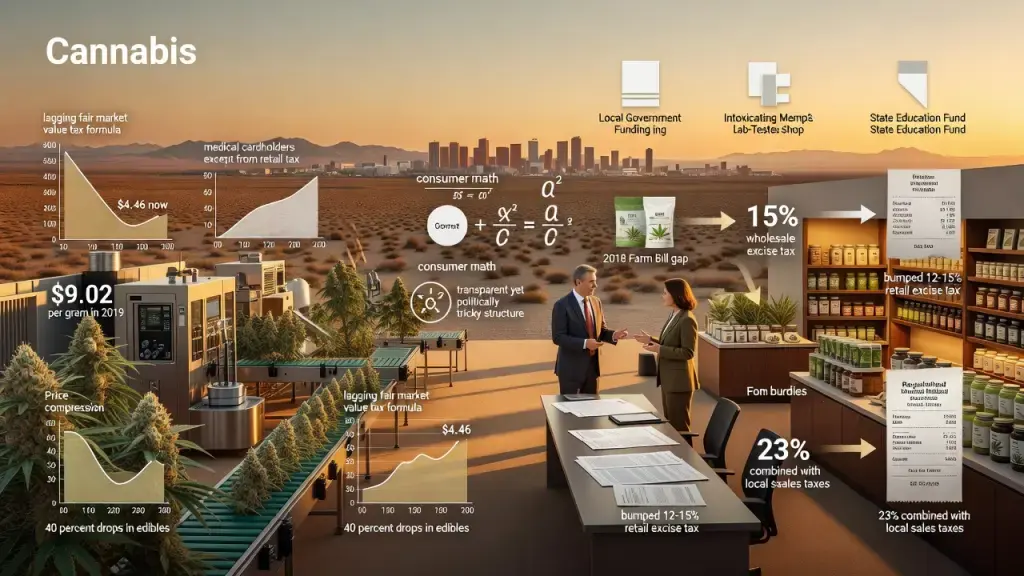
Nevada's cannabis excise tax revenue has fallen 40 percent since peaking in 2021, and state lawmakers are now studying whether the tax structure built for a brand-new industry in 2017 still fits a market that has settled into something steadier and cheaper. A legislative subcommittee has spent the past interim period examining whether Nevada should scrap its wholesale cannabis tax entirely and shift that burden onto retail sales instead.
Price Compression Is Squeezing the Wholesale Tax Base
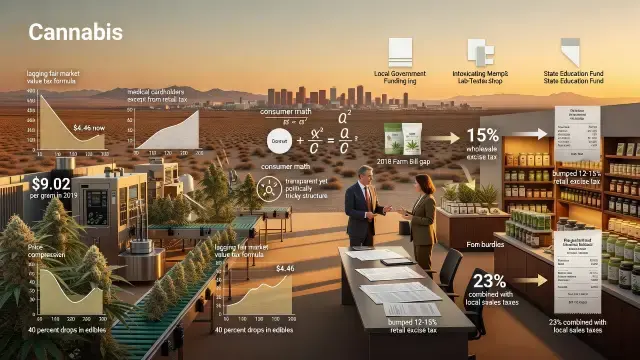
The numbers behind the decline tell a fairly straightforward story. Flower that sold for $9.02 a gram in 2019 is now going for $4.46 - roughly half. Infused edibles dropped about 40 percent over the same stretch. That's what a maturing market looks like: more competition, better production efficiency, and a lot more supply chasing the same customer base. Fair enough, that's a normal trajectory for a regulated industry finding its footing. The problem is that Nevada's wholesale tax is pegged to a "fair market value" formula, and cultivators have long argued that formula hasn't kept pace with how fast prices have fallen. When the metric lags the market, growers end up paying tax on value that no longer exists at the counter.
What Restructuring Would Actually Mean for the Supply Chain
The subcommittee's report, to its credit, doesn't recommend anything - it just runs the numbers. Eliminating the 15 percent wholesale excise tax and folding that revenue into the 10 percent retail excise tax would require bumping the retail rate to somewhere between 12 and 15 percent, according to the committee's analysis. That's not a small technical tweak. It reshuffles who pays what and when. Right now, the wholesale tax gets baked into pricing before a product ever reaches a dispensary shelf, which makes it invisible to the consumer but a real cost center for cultivators and processors. Move that tax downstream to retail, and suddenly it's a line item consumers see directly on their receipt - a more transparent structure, as at least one lawmaker noted, but also a politically trickier one, since nobody enjoys watching a tax rate climb on a printed invoice.
Cannabis Compliance Board Executive Director Michael Miles framed it as swapping one large tax for a smaller increase elsewhere - "not guaranteed it's going to even out," he said, "but the idea is that it should even out." That's an honest way to put it. In theory, if cultivators are no longer absorbing the 15 percent wholesale hit, wholesale prices could eventually drop, and retailers could pass some of that savings along even with a higher retail rate. In practice, though, nothing in the report assumes that happens on day one. Economist Erica Scott noted the working assumption is that cultivators would initially pocket the difference as profit rather than cut wholesale prices right away - which means for a while, consumers could simply be paying more.
The Consumer and Local Government Math
Recreational buyers currently face a combined retail tax rate near 18 percent once state and local sales taxes stack on top of the excise tax. Under the proposed restructuring, that combined rate could climb to around 23 percent in Clark County, home to the state's highest local sales tax. Medical cardholders, who are exempt from the retail excise tax, likely wouldn't see much movement in the short term - one more reason this isn't a simple across-the-board fix.
There's also a distribution problem buried in the mechanics. The wholesale tax currently funds local governments and regulatory operations in addition to the State Education Fund. Eliminating it means lawmakers have to figure out how those recipients get made whole under a retail-only model, which is exactly the kind of unglamorous budget plumbing that can stall a bill even when the underlying policy has support.
Intoxicating Hemp Adds Another Layer of Pressure
Separately, the subcommittee looked at Nevada's unregulated intoxicating hemp market - THC edibles and drinks sold through a gap in the 2018 federal Farm Bill, often available in smoke shops and gas stations without the testing, packaging, or age-verification standards licensed dispensaries must follow. The subcommittee pegged that market at roughly $45 million annually, though it cautioned the data is thin. Clark County has already tried cracking down on unregulated hemp products this year, with limited success. The subcommittee's recommendation, if the market persists, is tax parity between intoxicating hemp and licensed cannabis - closing a pricing gap that currently lets untested products undercut regulated ones on cost alone.
No action was taken on any of this. The Interim Legislative Committee on Revenue may pick the issue back up for the 2027 session, likely with more data on consumer behavior and how other states' retail tax hikes have played out. For operators, the takeaway for now is simple: nothing changes yet, but the structural conversation isn't going away.