Commuter rail across the Helsinki metropolitan area will face months of significant disruption starting 1 June 2026, as Finland's transport authority HSL rolls out an ambitious summer works programme covering track upgrades, bridge repairs, and continued construction on the Espoo City Rail project. The disruptions run through early September - covering the full peak conference and business travel season - and the effects on journey times, airport connections, and corporate mobility planning are substantial enough to warrant advance preparation rather than last-minute improvisation.
What's Actually Being Closed, and When
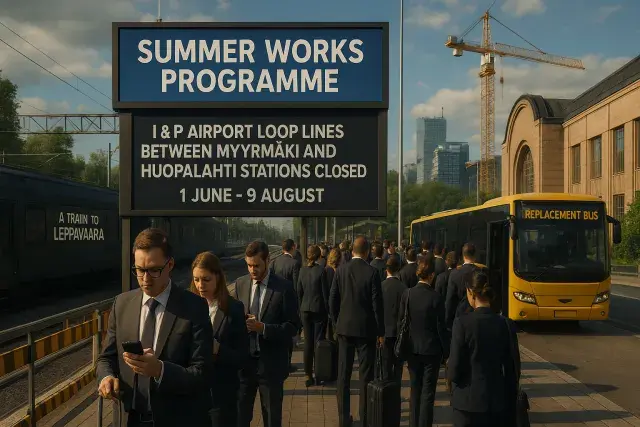
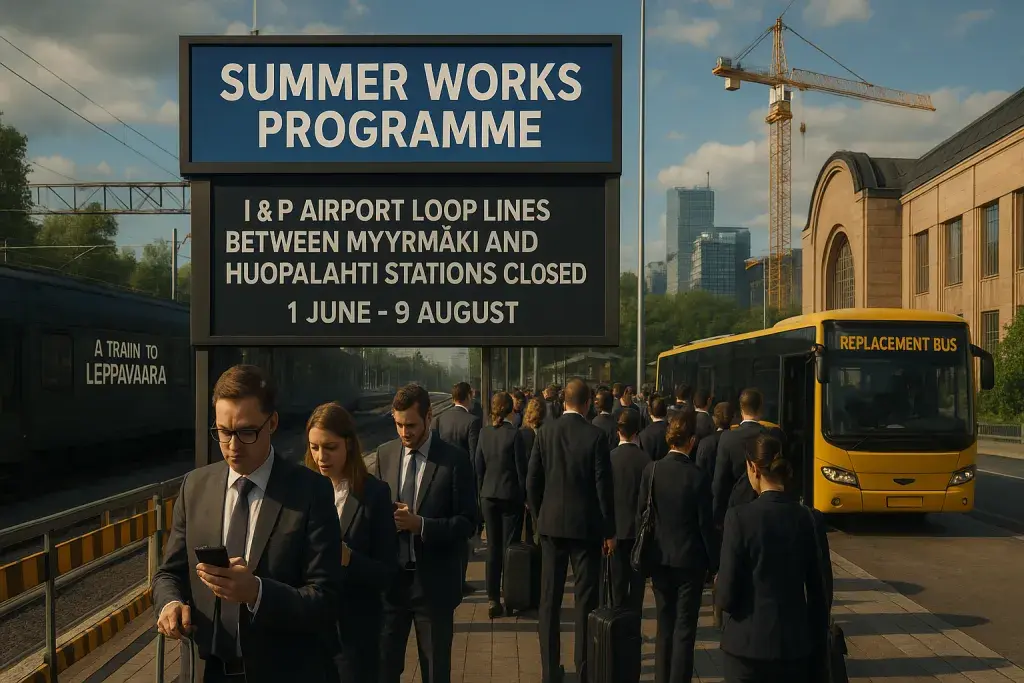
The single most disruptive closure is the complete suspension of rail traffic between Myyrmäki and Huopalahti from 1 June through 9 August. That break severs the I and P lines - the airport loops that connect Helsinki-Vantaa Airport to the city centre - forcing passengers onto replacement buses or rerouted alternatives. For anyone arriving on an international flight and expecting a clean 30-minute train ride downtown, that expectation will need to be reset.
The A-train, which runs between Helsinki Central and Leppävaara, will not operate at all this summer. Leppävaara is a significant destination in its own right - it anchors a dense cluster of technology and professional-services firms along the western rail corridor - so the A-line suspension isn't a minor inconvenience for the regional business community. It's a sustained operational gap. On top of that, long-distance services west of Leppävaara will be cut for five weeks following Midsummer, compounding delays for anyone moving between Helsinki and Espoo's western business districts.
The airport link, where it does remain operational, will run degraded. I-trains will skip four suburban stations and operate every 20 minutes instead of the standard ten-minute frequency outside peak hours. Flights are unaffected - but the surface connection has lengthened, and for time-sensitive arrivals, that gap matters.
The Espoo Business Districts Face a Particular Pinch
Employers based in Keilaniemi and Otaniemi - Espoo's two primary business and research hubs - should treat this period as a structured planning exercise, not a seasonal inconvenience to absorb on the fly. Both districts sit on the western rail corridor directly affected by the works. Commuters who normally rely on rail will face longer, less predictable journeys. Car-rental operators and ride-hail services are already anticipating higher demand; that means both higher fares and reduced availability during peak periods, particularly on Monday mornings and Friday evenings.
The practical levers here are familiar to any mobility manager who has dealt with infrastructure disruption: remote-work flexibility, staggered start times, and updated travel-approval protocols that build in realistic transfer buffers. What's striking, though, is the duration - three months is long enough that informal workarounds will erode. Organisations that don't formally adjust their commute policies now will spend the summer managing ad hoc crises instead.
International Visitors Need More Lead Time Than Usual
For business travellers coming to Finland from outside the EU, the rail situation adds a logistical layer on top of what is already an administratively complex entry process for certain nationalities. Visa requirements vary widely by country of origin, and the combination of longer airport-to-city transfer times and tighter rail schedules means that itineraries built around close connections - catching a train immediately after clearing customs, for instance - carry more risk this summer than in a normal year.
The simple fix is margin: more time between arrival and the first meeting, alternative routing researched in advance, and visa documentation confirmed well before departure. HSL's Reittiopas journey planner is available in English and provides real-time alternative routing; the agency will also push live disruption alerts through its mobile app and social channels. Hotels in the affected corridors have already flagged the likelihood of guest delays - which is a reasonable signal that the disruption will be visible, not just theoretical.
Why This Is Happening, and What Comes Next
HSL frames the summer programme as essential groundwork ahead of new commuter rolling stock arriving in 2028 - a capacity expansion designed for what is already Finland's busiest rail corridor. That context matters. The disruption isn't the result of deferred maintenance or a reactive patch; it's a deliberate short-term cost imposed to deliver a long-term capacity gain. Accessibility buses will operate at closed stations for passengers with reduced mobility, which addresses one equity dimension of the closures.
The honest read for any organisation with significant travel into or within greater Helsinki this summer: June through August 2026 will require more planning time, more scheduling flexibility, and more contingency budget than a typical year. Build that in early. The disruptions are predictable; the only variable is whether the preparation matches the scale of the problem.