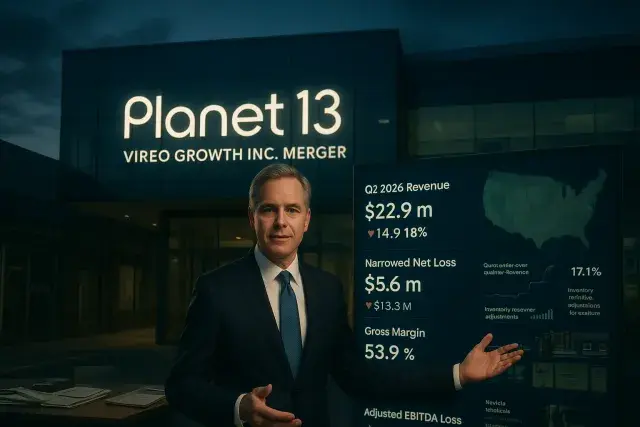
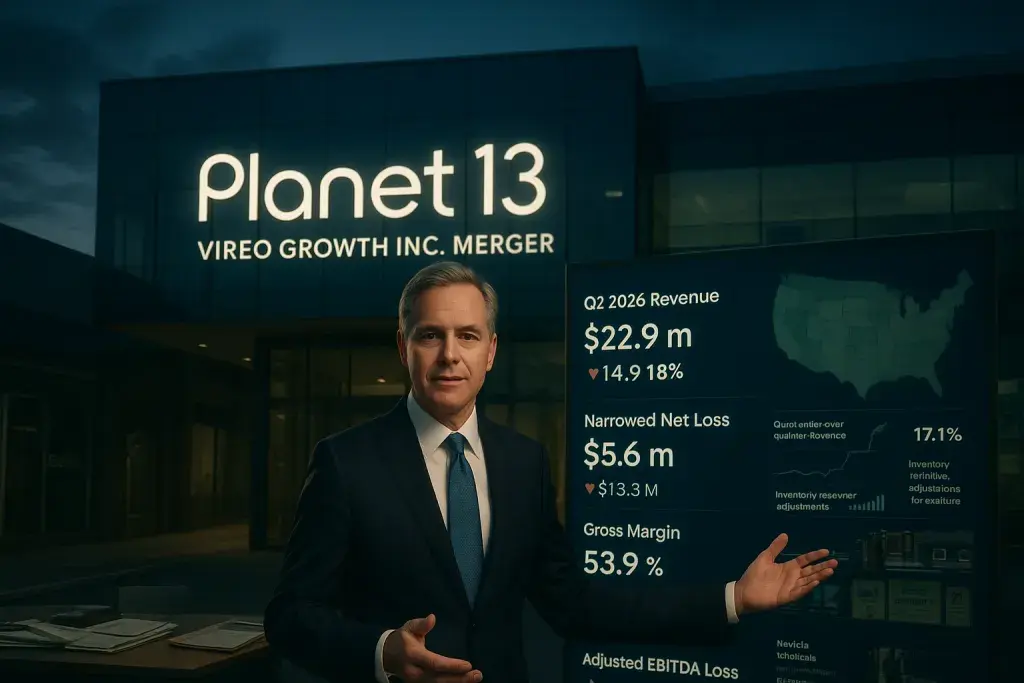
Planet 13 Holdings reported second-quarter 2026 revenue of $22.9 million, down 14.9% from a year earlier, but the multi-state operator's gross margin and Adjusted EBITDA both improved as it wound down its California operations and pushed through cost cuts ahead of a planned merger with Vireo Growth Inc. The Las Vegas-based company posted a net loss of $5.6 million, roughly half of last year's $13.3 million shortfall, and an Adjusted EBITDA loss of just $0.5 million.
A Smaller Top Line, But a Tighter Operation
The revenue decline traces directly to Planet 13's exit from California retail and wholesale, combined with ongoing price compression in Nevada and Florida - two mature adult-use markets where wholesale menus have gotten more competitive and margins have thinned accordingly. That's the trade-off multi-state operators keep making right now: shed underperforming footprint, absorb a smaller top line, and bet that the remaining markets carry better unit economics. Gross profit actually rose to $12.3 million, or 53.9% of revenue, up from 43.4% a year ago. Some of that lift came from a one-time $1.0 million reduction in the Company's inventory reserve for Florida distillate, as stronger Florida sales worked down excess product sitting in inventory. Strip that adjustment out and gross margin still landed at 49.5%, a meaningful improvement that reflects procurement discipline and the California wind-down rather than accounting noise alone.
Florida's Momentum and the Cost-Cutting Math
Florida revenue grew 17.1% quarter over quarter, a notable signal given how much capital and attention multi-state operators have poured into that market's medical program and its evolving distribution rules. Total expenses fell 17.7% to $15.2 million, driven by company-wide cost initiatives - the kind of belt-tightening that shows up in headcount, SKU rationalization, and renegotiated vendor terms rather than any single dramatic move. For dispensary operators watching from other states, the lesson is straightforward: in a market defined by wholesale pricing pressure, the operators who protect margin are the ones who control procurement costs and inventory turns, not just those chasing revenue growth.
Balance Sheet Pressure and the Path to a Merger
Cash and restricted cash stood at $16.5 million, up modestly from year-end 2025, while total liabilities crept higher to $105.5 million against total assets of $144.3 million. Those are not alarming numbers on their own, but they underscore why Planet 13's leadership has framed the pending Vireo Growth merger as a scale play. Co-CEO Bob Groesbeck said the deal gives shareholders a stake in a "larger, more efficient combined company," language that signals the broader consolidation pressure building across state-legal cannabis: smaller, single-state or regionally concentrated operators increasingly find it hard to compete on purchasing power and distribution against combined entities with deeper balance sheets. Because the merger is pending, Planet 13 is skipping its usual earnings call this quarter - a detail that matters less for investors than for the operational teams now managing integration planning alongside day-to-day compliance work, inventory reconciliation, and store-level execution.
What Operators and Suppliers Should Watch
- Continued wholesale price compression in mature markets like Nevada and Florida is squeezing margins for cultivators and processors alike, not just retailers.
- Inventory reserve adjustments, like the Florida distillate write-down reversal, can meaningfully swing reported gross margin in a single quarter - a reminder to read non-GAAP adjustments carefully.
- Merger and acquisition activity among multi-state operators is likely to accelerate as companies weigh scale against standalone survival in markets with persistent oversupply.
- Recent regulatory approvals, including OMMU sign-off on a Florida BHO extraction facility, show that operational expansion and compliance work continue even amid corporate restructuring.
None of this changes the underlying reality facing regulated cannabis retail: margins remain thin, compliance costs are real, and consumer protection through lab testing, compliant packaging, and age-verified sales remains the baseline expectation regardless of which corporate entity owns the storefront.