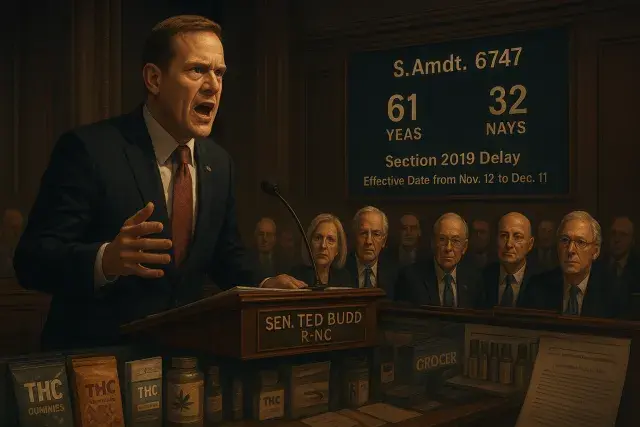
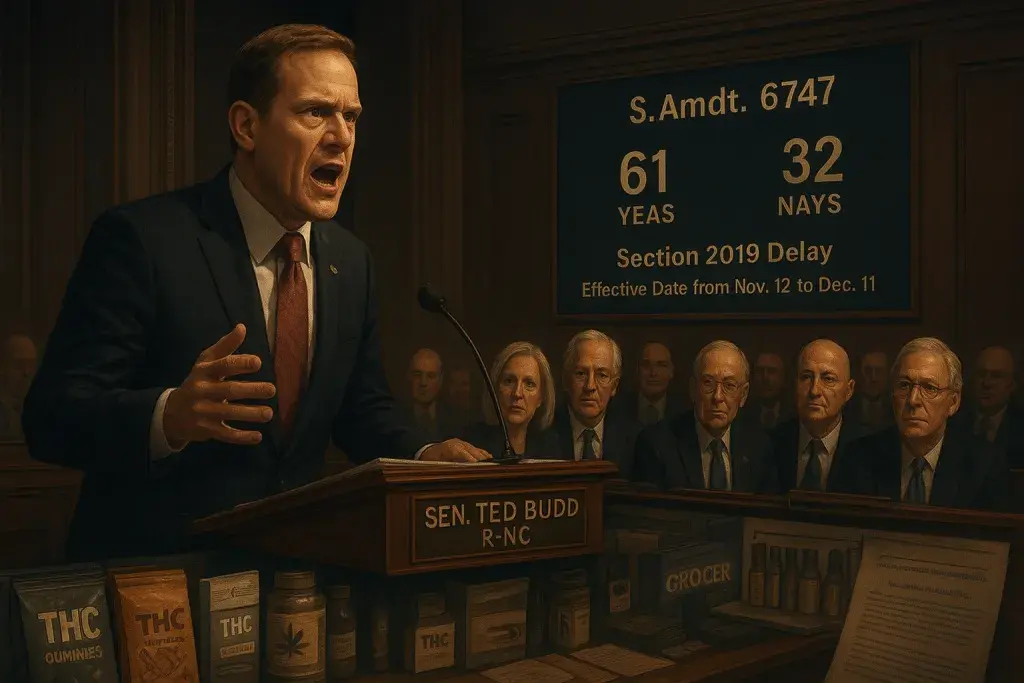
A one-month delay in federal hemp restrictions will stand after the Senate voted 61-32 on Aug. 8 to table an amendment from Sen. Ted Budd, R-NC, that would have kept the Nov. 12 effective date intact. The vote preserves Section 2019 of the continuing resolution, which pushes implementation of last November's hemp law to Dec. 11 instead. For operators selling intoxicating hemp-derived products, that extra month is not a resolution - it's a reprieve, and a short one at that.
The underlying law, approved by Congress in November 2025, rewrites the federal definition of hemp to account for total THC rather than delta-9 THC alone, and it caps combined THC and similar cannabinoids at 0.4 milligrams per container in finished products. That threshold would functionally eliminate most THC beverages, gummies, vapes, and THCA flower currently sold in convenience stores, smoke shops, and even some grocery chains. Retail operators watching this fight closely should note that the compliance stakes extend well beyond hemp; multistate cannabis operators navigating New York's evolving adult-use market are already leaning on tools like op dispensary software for New York to keep seed-to-sale tracking, COA management, and point-of-sale compliance aligned with shifting state rules - a preview of the kind of operational overhead intoxicating hemp retailers may soon face nationally. op dispensary software for new york
Budd's amendment, S.Amdt. 6747, drew 14 cosponsors, including Sens. Thom Tillis, Kirsten Gillibrand, John Cornyn, Chuck Grassley, Pete Ricketts, and Mitch McConnell - a coalition that crossed party lines but fell well short of the votes needed. Budd framed the fight in public-health terms, citing North Carolina emergency-department data showing cannabis-related visits among minors rose sharply between 2017 and 2025, and pointing to packaging that mimics popular snack and candy brands as a specific concern for retailers stocking these products near checkout counters.
Why the Delay Matters for Retailers and Suppliers
Here's the catch for anyone in the supply chain: a 30-day delay changes almost nothing operationally unless Congress acts within that window. Convenience stores, smoke shops, and hemp-focused retailers still need to plan wholesale menus, manage existing inventory, and decide whether to keep ordering products that could become illegal to sell in a matter of weeks. The National Association of Convenience Stores and the US Hemp Roundtable were among 105 organizations that wrote to Senate leadership backing the delay, arguing it buys time for Congress to build actual regulation - age verification, testing protocols, good manufacturing practices, and restrictions on synthetic cannabinoid imports - rather than a blunt THC cutoff that removes most products from shelves outright.
That argument didn't move Budd, Ricketts, or Sen. Tom Cotton, R-Ark., who pushed back during a tense closed-door Republican lunch where a White House legislative affairs official reportedly told senators the administration would not seek a further extension beyond Dec. 11. The exchange, reported by Axios, signals that the White House views this delay as final, not a rolling grace period - a distinction operators should take seriously when planning inventory and wholesale commitments into the fourth quarter.
North Carolina's Parallel Fight Over State Law
The federal dispute mirrors an unresolved standoff in Raleigh, where House Bill 328 would write the same 0.4-milligram threshold directly into North Carolina law rather than relying on federal timelines. The Senate adopted the conference report 37-6 back in July, but the House has repeatedly declined to act, leaving the bill parked in the Rules Committee. Speaker Destin Hall has acknowledged lawmakers broadly agree the state's largely unregulated hemp market can't continue as is, even as they remain split on whether prohibition or tighter regulation is the better fix.
That distinction matters for compliance planning. Because HB 328 would embed the THC limit in state statute, North Carolina's restriction could survive even if Congress delays, amends, or abandons the federal standard altogether. Retailers operating across state lines, or wholesalers supplying North Carolina accounts, should treat state and federal timelines as separate compliance tracks - not assume one automatically follows the other. For now, both remain unresolved, and operators are left managing inventory, labeling, and vendor contracts against two moving deadlines rather than one.