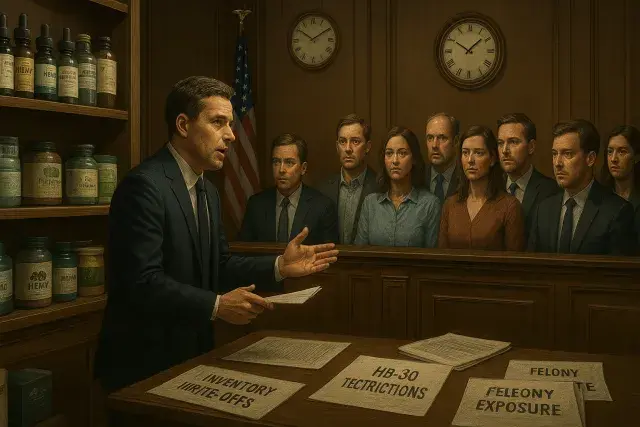
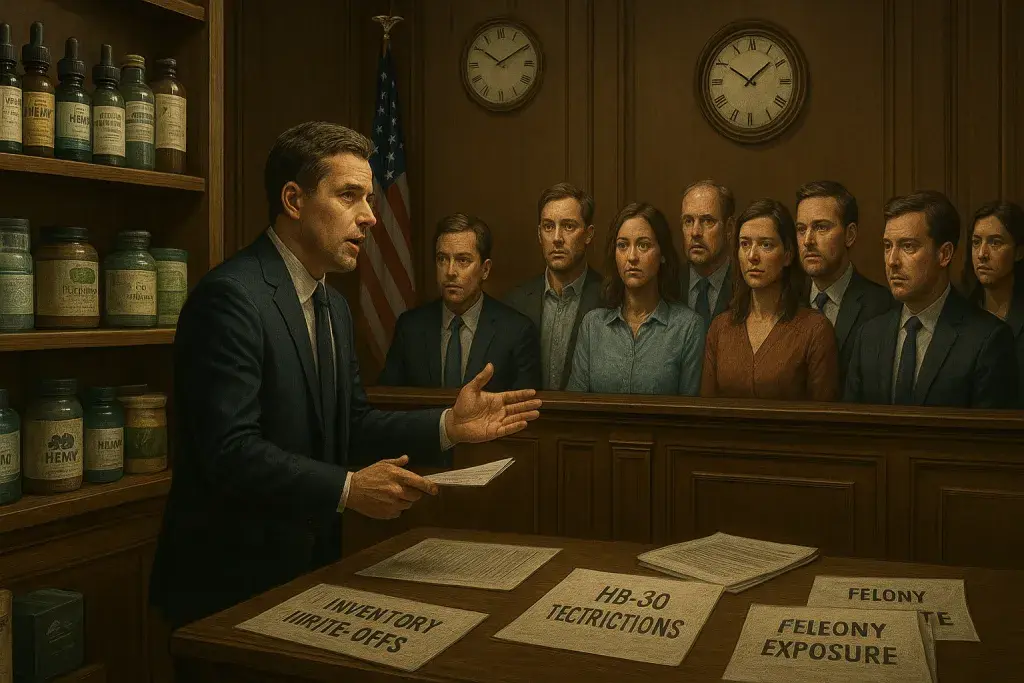
A federal judge in Virginia spent nearly five hours Wednesday weighing whether to pause a new state law that would upend how hemp products are sold across the commonwealth, just days before the rules take effect. Seven hemp businesses asked U.S. District Judge Robert S. Ballou for a temporary injunction blocking enforcement of House Bill 30's THC restrictions, which are scheduled to kick in Aug. 15. No ruling came Wednesday, though the plaintiffs' attorney, Chap Petersen, said he expects a decision within days.
The case turns on a narrow but consequential change: Virginia's budget language eliminates the 25-to-1 CBD-to-THC exception that had allowed a wide range of hemp-derived products to stay on store shelves, replacing it with a flat two-milligram total-THC-per-package cap. That is a steep drop for a market built around higher-ratio tinctures, gummies, and beverages, and it effectively reclassifies a large share of existing inventory as non-compliant overnight. States around the country are moving in different directions on this question - some tightening THC thresholds like Virginia, others building out structured adult-use frameworks with their own testing and packaging regimes, a pattern retailers can already see playing out in places like New York, where new york cannabis laws have taken a notably different regulatory path toward hemp and cannabinoid products.
Why the Timeline Is the Real Fight
The legal argument isn't really about whether Virginia can regulate hemp-derived THC - states generally can. It's about compliance runway. Petersen's core claim is that the governor didn't sign the bill until June 29, leaving business owners roughly six weeks to unwind product lines, renegotiate wholesale menus, and figure out what to do with crops already in the ground. Hemp, unlike a slot machine or a piece of retail equipment, can't simply be relocated across a state line when the rules change. Plants put in the soil in April, with harvest expected around October, were planted under one regulatory assumption and may be harvested under another entirely. That agricultural lag is the crux of the operators' hardship argument, and it's a fair one: compliance timelines that work for software updates don't necessarily work for row crops.
Inventory, Liability, and the Midnight Problem
Set aside the constitutional questions for a moment. The more immediate operational nightmare for dispensary and hemp shop owners is what happens to product sitting on the shelf when the clock strikes midnight on Aug. 15. Cody Moorefield, owner of Simply Hemp in Collinsville, put it plainly: products legal at 11:59 p.m. could become unsellable, and potentially criminal to possess for sale, one minute later. That's not a theoretical compliance gap - it's a felony-exposure problem for otherwise licensed operators who did nothing wrong except keep operating under rules that existed until the deadline hit. For retailers anywhere, that kind of abrupt reclassification raises real questions about inventory write-offs, lab testing obligations under a new standard, and whether existing certificates of analysis even mean anything under the revised definition of legal hemp.
What an Injunction Would and Wouldn't Fix
Petersen was careful to frame the request narrowly. The lawsuit isn't asking the court to strike down HB 30 outright - at least not yet. It's asking for breathing room: a pause on enforcement that would let businesses sell down existing inventory while the underlying constitutional claims, including a potential unconstitutional-takings argument, work through the courts. If Ballou grants it, operators get time and arguably leverage to push the General Assembly for a legislative fix before facing a trial on the merits next year. If he denies it, the two-milligram cap and the end of the 25-to-1 exception take effect Saturday as scheduled, and the broader lawsuit continues on a much slower track - cold comfort for a business owner staring at a walk-in cooler full of product that may no longer be legal to sell.